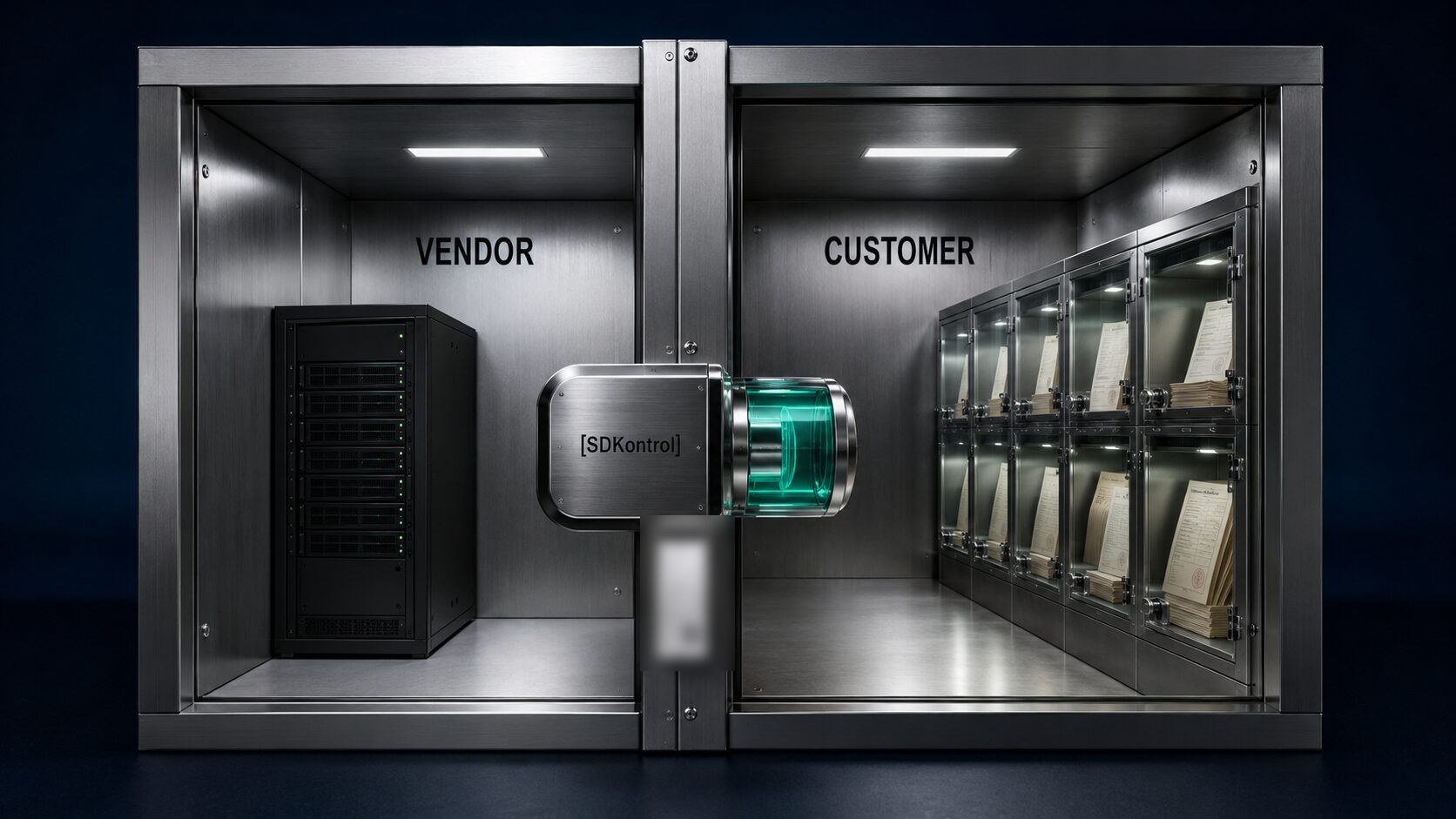
SDKontrol is the runtime engine, licensed as infrastructure. It runs any model, yours or a third party's, sealed and local inside the buyer's own environment, architected to make no outbound call, and it signs a record for every decision. No API. No phone-home. The claim is structural, not a policy promise.
SDKontrol unlocks markets that cloud-dependent AI cannot enter.
Put advanced AI inside the customer-controlled environment, so companies can serve regulated, on-premises, edge and connectivity-constrained environments without requiring sensitive data to move to an external model service.
Can we offer our AI inside a customer’s controlled environment instead of requiring them to use our cloud?
Yes. The vendor ships its model sealed inside the customer’s environment, and the control travels with it.
Can we serve regulated or connectivity-constrained customers our current architecture cannot reach?
That is the market SDKontrol unlocks: the buyer that said no because the data would have to leave.
Can we take advanced AI capability to the data rather than moving sensitive data to the model?
The model travels. The data stays. AI moves to where the data already is.
SDKontrol can open deployments that cloud-dependent architectures cannot support.
Some regulated, sovereign, on-premises, edge and connectivity-constrained environments cannot send sensitive data to an external model service. SDKontrol brings the model and its control into the customer-controlled environment instead.
The control ordinarily sits inside the vendor’s product, so it answers to the vendor. SDKontrol removes both problems at once. The vendor ships its model sealed inside the customer’s environment, runs every inference through the gate, and writes a record for each decision, signed as it is written. The customer gets the evidence. This can make additional customer environments technically addressable.
Enormous capability compressed into a sealed, portable file. The intelligence is portable. The infrastructure is the buyer’s.
The buyer of SDKontrol is the vendor. What the vendor buys is access to environments it could not previously serve. Validation, procurement and model-risk review still apply; this removes the egress objection, not the others, and it is honest about that.
The control boundary between vendor and customer
Where infrastructure is not the given
Governed AI does not have to depend on infrastructure the customer does not control.
The sealed deployment was built for the bank that would not let a model call home. The same property answers a larger question: what happens where the cloud is not a given at all.
A clinic in a region with intermittent connectivity. A field response after the network went down with the power. A school system that cannot lawfully send a child's work to another country. A regulator in a jurisdiction with no domestic hyperscaler region. In each of them the ordinary answer is that governed AI is unavailable, because control was sold as a service that has to be reachable.
Regulayer runs where it is installed. Keys are generated on the machine that will use them. Records verify against public mathematics by anyone holding the file, offline, with no account and no call to us. That is the same engine the regulated buyer licenses, working in the place the cloud has not reached, and it is why the independence proposition is not a privacy footnote. Your authority does not have to live in somebody else's cloud.
The same wall, in five markets
Pharma and biotech
21 CFR Part 11, EU GMP Annex 11. The model runs inside the validated system, and signed records feed the audit trail Annex 11 already requires.
Defense and federal
Programs whose policies forbid any outbound path. Model and inference stay inside the boundary, and the security officer verifies records offline.
Financial services
SEC and FINRA supervision, data residency, bank secrecy. No signal, no position, no client identifier crosses the wire.
Healthcare
HIPAA audit controls over ePHI. The chart never leaves the estate; the record of what the system did is still provable.
Legal
Privileged work product stays inside the boundary, so there is no third-party custody for a court to read into a waiver.
The model travels. The data stays.
What the license carries
The kernel and the gate
Control outside the governed model, integrated into your stack without moving the trust boundary. After integration the control continues to answer to the customer, not to you, and not to us.
The record format and the open verifier
Decisions are signed into the versioned record format as they are written, verifiable by anyone holding the file, permanently, with nothing from us. Older records never stop verifying; newer records are never rejected by older verifiers.
Fails closed
Run it without a current license, or pry it open, and it fails closed. Sealing raises the cost of extracting the model, but it is not theft-proof against a host that fully controls its own hardware; host-proof sealing requires a hardware enclave, available on the hardware-key deployment path.
Infrastructure, not certification of compliance
SDKontrol produces the evidence. It does not certify that a deployment complies with any regulation; that determination belongs to the relevant authority.
Deployment
It runs on your machines, and enforcement and evidence signing require no network egress.
Regulayer operates within the customer-controlled environment. Ordinary enforcement and evidence signing do not require network egress, and the underlying work is not sent to Regulayer. Where independent time evidence is used, the underlying content remains within the customer environment.