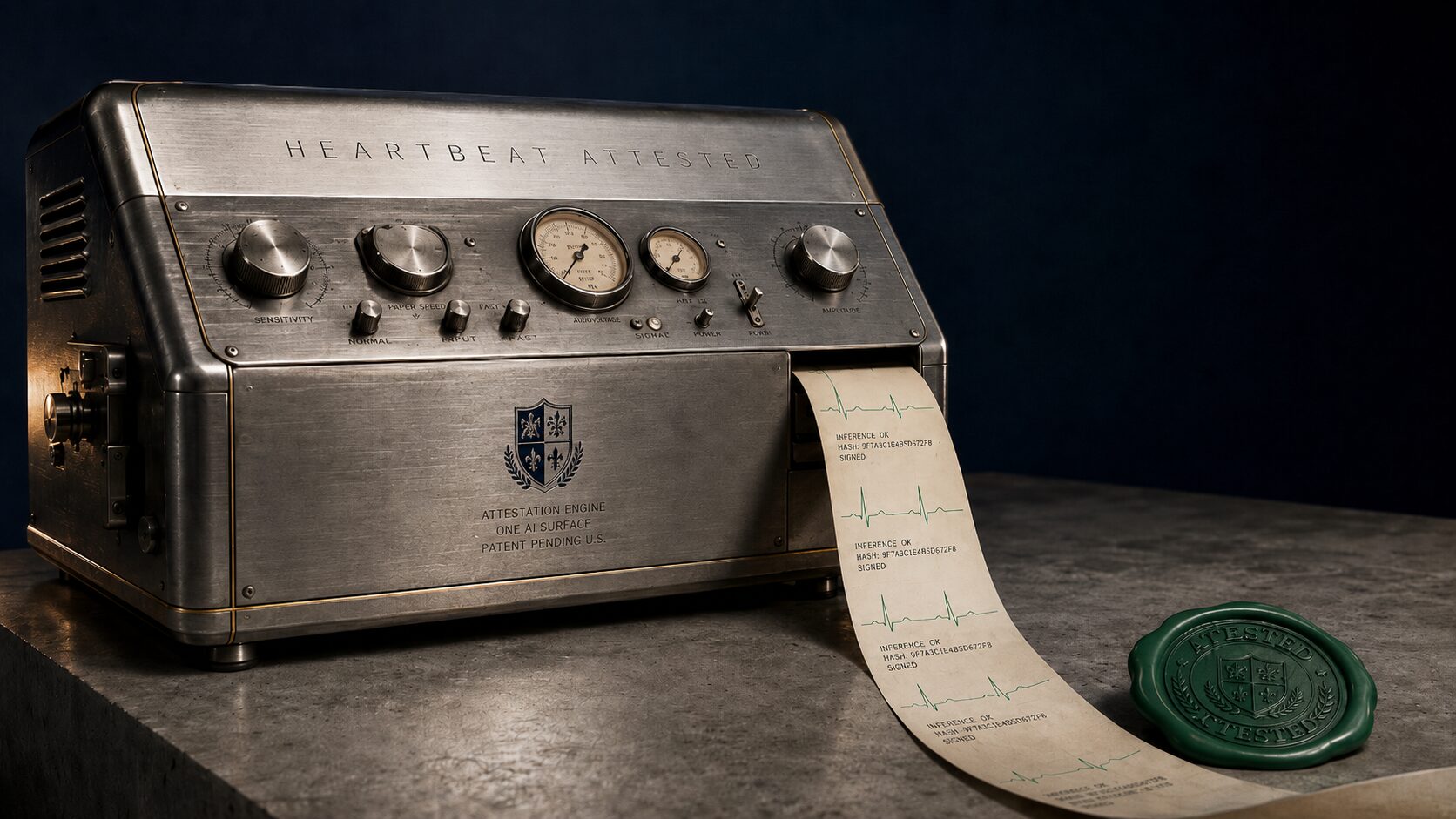
Heartbeat signs every output of one AI deployment. When the AI behaves correctly, the pulse is steady. When it drifts, the pulse changes, the receipts show it, the ledger keeps the record.
The proof is yours, produced locally, with no outbound call required.
Heartbeat™ · pulse steady
Alive
deployment · your-deployment-01
last beat · just now
signed · hash-chained
auditor-verifiable, no contact with us
Any auditor checks the chain themselves, with an open script.
A doctor takes the pulse before reading the chart.
Heartbeat is that, for AI. Every governed output is a beat: a signed receipt.
The beats hash-chain into a ledger any auditor can verify with an open-source script, without ever contacting you. A consistent record shows that the monitored state remained within the conditions being recorded. A change in the record shows when the monitored state moved outside those conditions. The evidence is the byproduct of running the AI, not a report assembled afterward.
Heartbeat creates a signed record of governed AI activity over time.
Each governed event can produce a signed, chained record that can later be independently verified. The resulting evidence can support monitoring, audit and review requirements without requiring the underlying work to be sent to Regulayer.
Heartbeat does not determine whether the system was legally compliant, whether an individual decision was correct, or whether privilege applies. It preserves evidence that an authorised reviewer can evaluate.
The license buys the evidence, not a verdict on the fine.
The world has already ruled on AI without proof.
United States v. Heppner, S.D.N.Y., February 2026
The tool's own terms decided the confidentiality question.
A criminal defendant prepared 31 documents using a consumer AI tool. The court held they carried neither attorney-client privilege nor work-product protection, because the platform's own terms permitted collection, training and disclosure to third parties. It did not hold that using AI waives privilege. It held that those terms defeated confidentiality for those documents. The split, read in full.
Where the work stays on the machine that made it, fewer third parties hold it. What that means for privilege in a given matter is for counsel, not a property we claim.
UnitedHealth nH Predict, Senate report and litigation
The record existed. The people affected could not reach it.
A Senate subcommittee documented the skilled-nursing denial rate rising from 1.4% in 2019 to 12.6% in 2022, working from more than 280,000 pages of internal documents. In March 2026 a federal court ordered production of how the system was built and used. The operational allegations in the class action are contested by UnitedHealth and remain allegations. The record, graded.
A per-decision receipt gives every decision an artifact the reviewer verifies themselves, at the time rather than on discovery.
Italian Garante, Replika, February 2023
An urgent limitation on processing, over risk to minors.
Italy's data protection authority ordered an urgent temporary limitation on the processing of Italian users' data, citing risks to minors. It is here for the shape of the problem rather than as a finding about the operator: a regulator reviewing an age-related control works from what the operator is able to show it.
The signed stream is evidence a regulator inspects directly, without taking the operator's word.
One pulse. Many surfaces.
The architecture does not care what the AI is doing. It cares that every governed output leaves a beat. The buyer and the regulation change with the surface, the license shape does not.
Legal AIEvery prompt and output gets a beat. Receipts preserve a record of scope, review and handling that counsel can evaluate alongside applicable privilege requirements. ABA Rules 1.1 and 1.6.
BiotechEach AI-assisted decision is a signed beat whose recorded timestamp is covered by the signature, inside the validated environment. 21 CFR Part 11, EU GMP Annex 11.
SemiconductorEvery governed output stays inside the controlled boundary. The verifier confirms it without ever seeing the content. ITAR, EAR.
HealthcareEvery AI-assisted decision leaves an audit artifact a compliance officer can produce on demand. HIPAA.
FinancialA signed record for every model decision, mapped to the records supervision already draws on. SEC, FINRA.
It is infrastructure, not a certifier.
It does not certify your compliance. It makes the evidence you bring to it.
You produce signed evidence. You and your auditor interpret it. You and your regulator settle it. No certifier sits in your chain, so there is no opinion to challenge in court. We hold nothing of yours. You hold the keys. You hold the evidence. We hold the filings. Patent pending. The verifier is public for anyone to check, never a lever we can pull on you.
Where it sits.
The pulse, and the memory.
Heartbeat is the pulse of one AI surface: outputs signed as they are written, beat by beat. The Witness is the whole estate's memory: every moment across every tool, with the human decision sealed beside it. The record shows the monitored state and events captured for that deployment. The memory answers for everything it ran.
One pulse. Five surfaces. The same signed receipt.
The architecture does not care what the AI is doing. It cares that every output leaves a beat.
Privileged legal AIOne legal or productivity AI deployment inside a firm. Relevant to ABA Model Rules 1.1 and 1.6. Prompts and outputs are signed as they are written, beat by beat, and the record preserves scope, review and handling that counsel can evaluate alongside applicable privilege requirements.
Validated pharmaOne AI assistant inside a GxP-validated system. Relevant to 21 CFR Part 11 and EU GMP Annex 11. AI-assisted decisions are signed as they are written, each beat carrying a recorded timestamp covered by the signature, and inspectors verify the chain.
Export-controlled designOne design assistant inside an export-controlled environment under ITAR and EAR. Every governed output stays inside the boundary, and the receipt is the evidence that controlled material never left.
Cleanroom and bio-manufacturingOne AI advising on release or environmental-monitoring decisions. Relevant to GMP and ISO 14644 reconstructability. When an event is investigated, the chain is the record.
Consumer AI in EuropeOne consumer-facing AI tool. Relevant to EU AI Act Article 50 transparency and synthetic-content marking. The evidence is the byproduct, not a report written afterward.
How the proof works
Three steps, one architecture.
Govern at the moment of output. It deploys inside your environment, bound to your license. Every AI output passes through it, and the decision to allow, refuse, hold, or escalate is made on local computation alone. The capability is local or it does not run.
Issue the receipt as a byproduct. Each governed event produces a signed receipt, chained to the one before it. Tamper-evident, append-only, signed on your machine. No outbound call is made, and nothing leaves.
Hand the proof to whoever asks. Export the bundle, and your auditor, counsel, or regulator runs the public verifier against your key. The chain matches or it does not. You never call us, and we never see your data.
Proof you can hold, made where the data lives, sent nowhere.
Clean answers.
The questions buyers ask first.
What counts as one AI surface?
One stable AI deployment with one identifier: a legal-AI deployment, a productivity-suite AI tenant, an enterprise model endpoint, an internal RAG, a customer-facing chatbot, a drug-discovery assistant. Heartbeat binds to that one deployment and signs every governed event from it. Three surfaces need three licenses. One surface serving a million queries needs one.
Does this make me EU AI Act compliant?
No. It produces verifiable evidence for one bound AI deployment, which is what an auditor or regulator needs to check the oversight of that deployment. Compliance is a posture across your whole estate. This is one strong piece of evidence in that picture.
Is this a compliance certification?
No, and that distinction protects you. We are infrastructure. You generate the signed evidence, you and your auditor interpret it, you and your regulator settle it. No certifier sits in your chain whose opinion can be challenged in court. You hold the keys. You hold the evidence, and the verifier is public for anyone to check.
What happens if the AI drifts?
The signed record shows it, contemporaneously. The product does not decide what drift means. Your team, your auditor, your counsel, or your regulator interpret it. The point is that the evidence is there, signed and verifiable, before anyone asks.
What support is included?
The software, the documentation, the install guide, the audit-defense playbook, and the open-source verifier, delivered at purchase. It self-installs. Support contracts, SLAs, and consulting are separate engagements.
How is this different from a compliance dashboard?
Different job. Readiness and policy tooling organises what an organisation asserts about its controls and helps it prepare for a certification. Heartbeat produces the per-decision evidence underneath that question, signed as the system runs and checkable by the party you answer to without contacting us. One records what you say. The other records what happened. We compete with the absence of evidence. The six classes of AI control, and what each one's record establishes and who has to be believed, are set out without vendor names at what systems prove.
What does my engineering team have to do?
Install it and point your AI pipeline at a single endpoint. About one engineer-day for a team that already runs containers. The public verifier confirms the integration is correct before you ever show evidence to a regulator.
Does it phone home?
No. It runs entirely on your infrastructure. The signing key is generated on your machine and never leaves it. No telemetry, no analytics, no remote update. Block all outbound traffic at your firewall and it still works.
What happens if my license expires?
It keeps running. New outputs stop being covered by the Heartbeat Attested mark, but every receipt signed before expiry remains independently verifiable. A lapse creates a gap going forward, never backward.
What if EU AI Act enforcement changes?
The same evidence stream is responsive to NIST AI RMF, FDA and EMA principles, EU GMP Annex 11, ISO 42001, and the US state AI acts. The infrastructure you buy for one cliff defends you under the next.
Who is behind it?
Regulayer · Patent pending.
What is the difference between Heartbeat Attested and Regulayer?
Heartbeat covers one bound AI deployment. Regulayer covers the whole estate, adding fleet aggregation, drift monitoring, and the broader claim set. Start with Heartbeat on one surface, add more over time.
Heartbeat produces tamper-evident evidence for a named regulation. It is evidence input, not a compliance certification, attestation, or legal determination, and not a SOC 2 report, ISO certification, or audit opinion. Confirm deadlines and citations with counsel for your jurisdiction.
Related capabilities
Drift ControlCurrent human authority before release.
FailStopAn external stop before a consequential action executes.
The WitnessWhich human decision governed at the time.
HumanMarkObservable human participation, recorded.
SDKontrolGoverned intelligence inside the customer’s environment.