SDKontrol™ · the runtime engine, licensed as infrastructure
The model travels. The data stays. No API, and architected to make no outbound call.
SDKontrol is how a vendor gets into regulated markets it was locked out of. It runs any model, the vendor's own or a third party's, sealed and local inside the buyer's own environment, makes no outbound call, and signs a receipt for every decision.
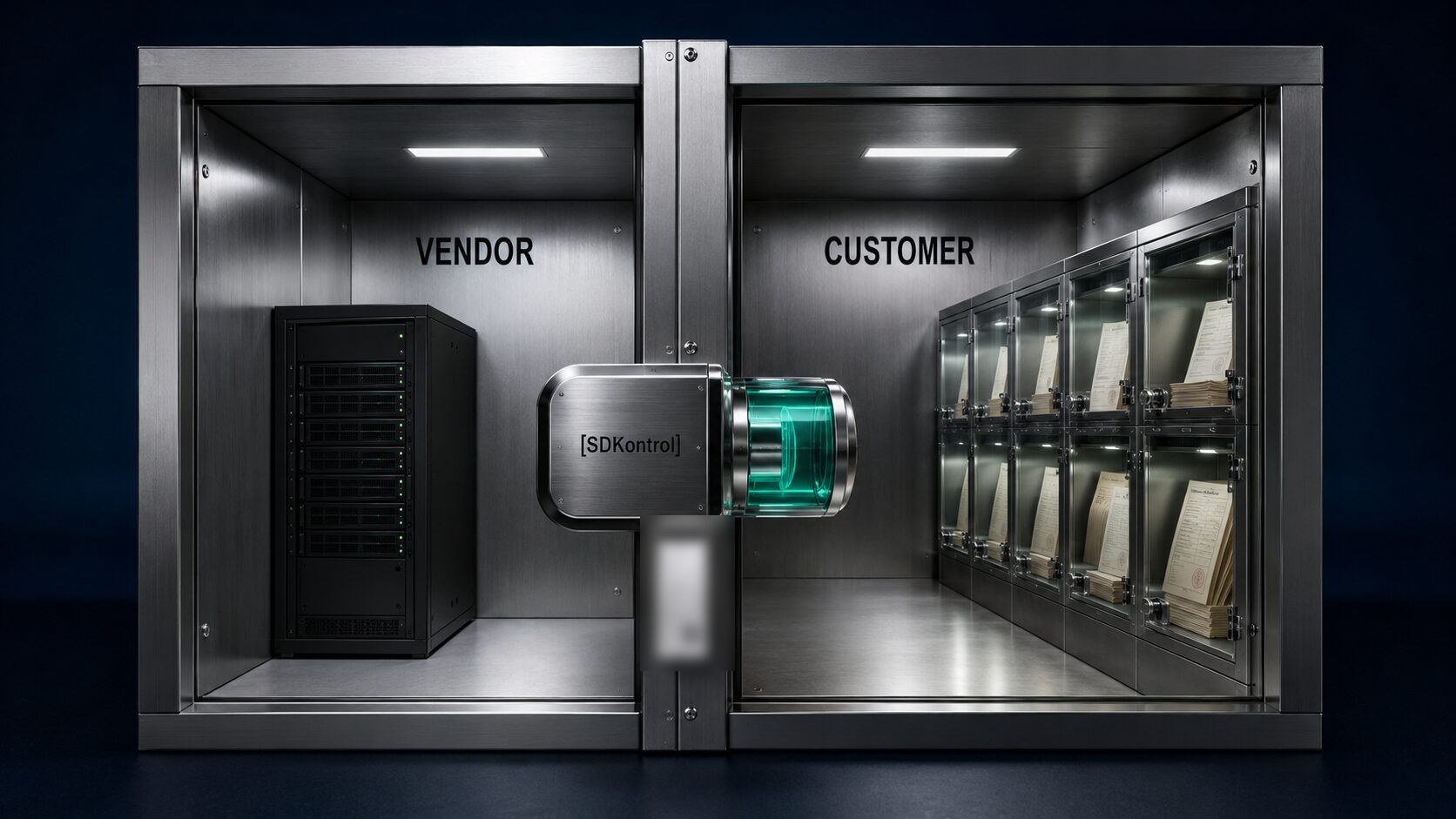
For two decades the answer was the same. The vendor could not promise the data would not leave, so the buyer said no.
Banking, pharma, defense, healthcare, legal, semiconductor. The dealbreaker was always the outbound call. SDKontrol removes it. The vendor ships its model sealed inside the customer's environment, runs every inference through the gate, and produces a signed receipt for every decision. The customer gets the evidence. The vendor gets the customer it could not reach before.
The buyer of SDKontrol is the vendor. What the vendor buys is the customers it could not reach.

Every regulated market has the same shape. Valuable AI, blocked at the door because the data cannot leave. SDKontrol removes that objection. It does not remove the others. Validation, procurement, and model-risk review still apply.
What it does.
The moment software pings out, every claim becomes a promise.
No pinging is not a limitation. It is the moat. Every privacy claim, compliance claim, residency claim, and trade-secret claim depends on what happens after the data leaves the customer's wire. SDKontrol™ is architected so the data does not leave. The claim is structural, not a policy promise. The chip becomes the destination, not the gateway. Less is more.

The unlock for locked-out vendors.
Banking. Pharma. Biotech. Legal. Defense. Healthcare. Semiconductor. Cleanroom operations. The reason was always the same: the vendor could not promise the data would not leave. The API was the dealbreaker.
SDKontrol™ removes the API. The vendor ships its model sealed and local inside the customer's environment, runs every inference through the enforcement gate, and produces a signed receipt for every decision. The customer gets the evidence. The vendor gets the customer. The buyer of SDKontrol™ is the vendor, and what the vendor buys is the customers it could not reach.
The new AI economy.
For twenty years software flowed to the cloud and the data flowed with it, and the cost of compliance, incident, and unverifiable claims rose on the same curve. The pattern reached its limit when AI entered regulated industries. The new economy reverses the flow: sealed, local, signed, licensed as infrastructure. The intelligence is portable. The infrastructure is the buyer's. The receipt is the commerce instrument. Enormous capability compressed into a sealed, portable file. The opposite of what the cloud-AI industry built for twenty years.
Five markets. One unlock.
Every regulated market has the same shape: valuable AI blocked at the first hurdle because compliance forbids outbound data. Remove the outbound objection and the vendor can compete where it was blocked. Other requirements, validation, procurement, model-risk review, still apply.
The same engine, licensed five ways. SDKontrol is the part a vendor builds into its own product.
Dolby for AI. ARM for AI. Verisign for AI.
SDKontrol is licensed the way Dolby licenses audio, ARM licenses chips, and Verisign licenses naming. You license the engine and build it invisibly into your own product. The end buyer never sees it by name, they see your product running governed and local. What you license is the way into the markets that were closed to you. Heartbeat is the same engine, self-serve, scoped to one surface.
The kill switch.
Run it without a current license, or pry it open, and it fails closed. Nothing runs, and a result cannot be passed off as genuine without the signature, which anyone can check.
Clean answers.
Regulated buyers will not let an AI tool make an outbound call, so any vendor that depends on one is locked out of the market. SDKontrol removes the call. The model runs sealed and local inside the customer's environment, with enforcement and a signed receipt as the byproduct of every inference. The vendor reaches the customer it could not reach before.
Every privacy, residency, confidentiality, and trade-secret claim rests on what happens after the data leaves the wire. If the software calls home, each of those becomes a promise instead of a proof. SDKontrol is built so the data does not leave. The claim is structural, not a policy.
The customer. It deploys inside the customer's own environment. The vendor licenses it into its own product. Neither the vendor nor we see the customer's inference traffic.
Enough to prove the gate ran on each inference and to chain the decisions into a verifiable record. The content of the inference is not in the receipt. The receipt is the proof, and the decision speaks for itself.
Two different protections, and they should not be confused. SDKontrol keeps the customer's data from leaving, the structural no-outbound-call property. Protecting your own model and code from the host is separate. It ships compiled with keys encrypted at rest, which raises the cost of extraction but is not theft-proof against a host that fully controls its own hardware. Host-proof sealing needs a hardware enclave, available on the hardware-key deployment path.
Same runtime, two licensing models, two buyers. Heartbeat Attested is the self-serve license scoped to a single AI surface, for compliance buyers at regulated enterprises. SDKontrol is licensed to AI and SaaS vendors as infrastructure they build into their own product.
No. It produces verifiable evidence. The audit, the regulator, or the court decides what the evidence means. It captures, it does not certify. Infrastructure, not certification.
A library lives inside the application, so the same process it is meant to govern can disable, reconfigure, or bypass it, and nothing proves it ran. SDKontrol runs as sealed infrastructure outside the model, holds the inference before it is released, and signs a receipt as the byproduct, so there is independent evidence the gate ran. It is the difference between a rule in the code and a control on the line.
By introduction. Tell us your product, your target buyer, and the regulatory regime you are entering, and we reply with a written scope before any call.
The intelligence is portable. The infrastructure is yours.