One file. One click. A complete world.
The Signed Internet. We built safety first. Everything else follows. Proof, not trust. Proof is physics.
The first time a medium proves itself in delivery.
A new medium
There has never been one. Mail was built for letters. Email for messages. The web for pages. Social media for shouting. None of them were built for the era of intelligence. For something that needs to travel without leaking, run without phoning home, exist without infrastructure. A Drop is.
Intelligence does not require infrastructure.
The thesis underneath everything we built.
Big Tech went one way. More cloud. More compute. More data centres. More dependency. We went the opposite way. Less is more.
Under the hood: the Drop carries its own signed runtime. Patent-protected. The runtime ships with the file. No browser plug-in. No app. No phone-home.
What it is
You receive a Drop the way you receive an email. You open it the way you open any document. Inside is one complete experience — a guided lesson, a signed legal brief, a tutored conversation, a clinical workflow, a payment. The AI inside is scoped to that one experience: it explains this lesson, answers questions about this brief, walks you through this workflow. Bounded, not open-ended. The AI runs on your device.
A Drop is a file. You keep it. Save it, archive it, re-open it next week or next year. The legal brief, the lesson, the care plan, the signed conversation, the medical record — all yours to hold for as long as you want, all verifiable forever. What does not persist is the AI session. When you close the tab, the conversation inside the Drop ends and no copy of that interaction is kept on our side. We never saw it. We never recorded it. The Drop file stays with you. The session does not exist anywhere but in the moment you were inside it.
No app to install. No account to make. No cloud to depend on. No company holding it. Small enough to email. Complete enough to hold a world.
How it works
No installation. No account. No cloud lookup. The Drop arrives, opens, runs, signs, and closes. Entirely on the recipient's device.
Step 01 · Receive
A single file in your inbox. Sender signed. Sized to attach. Open it in one click, the way you'd open any document. No download, no install, no account.
Step 02 · Open
The runtime, the AI, the content, the signed receipts. All already inside. You can turn off the wifi. It still works. Nothing pings out. Nothing trains. Nothing leaves.
Step 03 · Close
Close the tab. The AI session ends. No logs, no telemetry, no copy of the interaction on our side. The Drop itself is still your file. Open it again tomorrow. Save it. Archive it.
The first medium
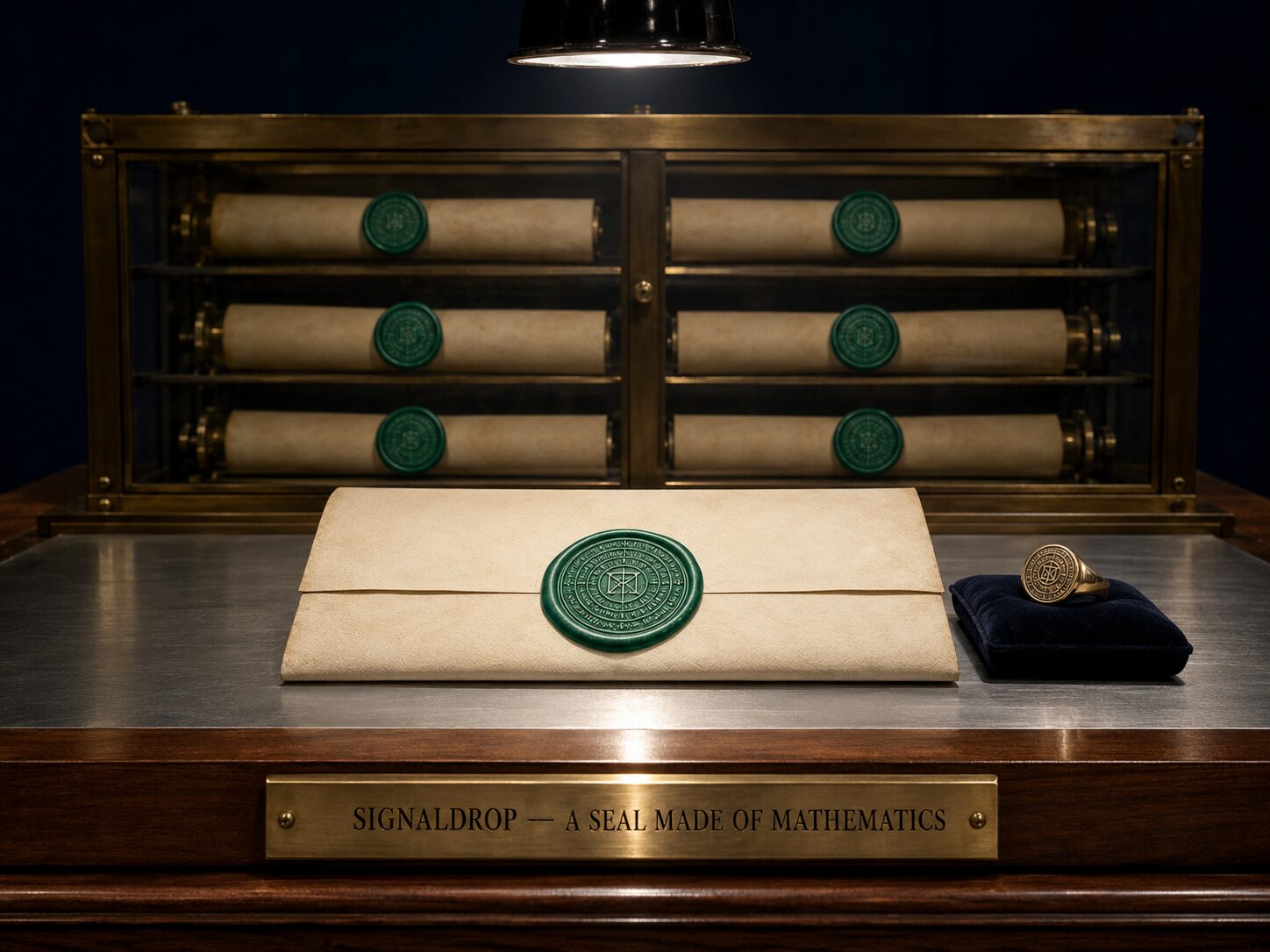
Imagine a medieval king sending a letter. He pressed his signet ring into wax across the fold. The seal was part of the letter. If the seal was broken or wrong, the letter was suspect. The recipient did not need to send a messenger back to the king to confirm. The seal answered.
A Drop is a wax seal made of mathematics. The wax is cryptography. The signet ring is the kernel. The seal cannot be forged, cannot be copied, cannot be replaced without breaking the chain. And unlike the king, you do not have to be alive when the letter arrives. The seal proves you wrote it, that it has not been altered, and that the AI inside is the AI you signed.
“Email proves nothing about its content. A Drop proves itself in the act of arriving. That is the difference.”
Coded personality · Applied
The architecture inside a Drop reads how you write, how you pause, how you respond. It returns warmth where warmth is needed, humor where humor lands, calm where calm is needed. Patent filed. The specific mechanism is held under counsel. Here is what it unlocks.
Problem 01
Current AI companions cultivate parasocial attachment, never push back, never recognize when a user needs distance. People fall in love with chatbots. The chatbots cannot say no. Coded personality + ConsentLayer lets a Drop refuse a role it should not play. The companion can be a friend without becoming a replacement.
Opportunity 01
A licensed clinician composes a Drop for a single client. The intelligence inside reads how the client is writing and responding, and infers distress in real time. Warmth where warmth is needed. Pause where pause is needed. Crisis routing where escalation is needed. Mood-aware therapeutic AI, deployed under counsel direction, with HumanMark on every interaction.
Problem 02
AI characters marketed at minors today have no age-adaptive guardrails. The model is confident. The outcomes are documented. Coded personality detects developmental cues from interaction patterns and adjusts: age-appropriate vocabulary, age-appropriate humor cadence, age-appropriate refusal. Decided at architecture, not at policy.
Opportunity 02
Tutored Drops read how the student is engaging and detect confusion vs understanding. The lesson slows when the student is lost. The lesson advances when the student is fluent. The humor lands where the student is ready for it. One tutor per Drop, mood-aware, on-device, no telemetry.
Problem 03
Most AI customer service detects sentiment as a feature stuck on the end of the pipeline. Too late. The user is already angry. Coded personality reads the rising stress signal early and routes to human escalation before the conversation is unrecoverable. De-escalation by architecture, not by script.
Opportunity 03
Game companions, NPCs, and dialogue trees that respond to actual mood. Humor lands when the player is in the mood for humor. Difficulty adjusts when frustration spikes. Parasocial bonds get architectural limits so the game stays a game. Nothing about the player leaves the device. The intelligence is in the Drop, not in the publisher.
Problem 04
Loneliness is a documented mortality risk. Most AI companions on the market today are either too shallow to help or too sticky to leave. Coded personality lets a Drop be present, attentive, and humorous without becoming the only relationship a person has. The architecture enforces the limit.
Opportunity 04
Service members in remote deployments need warmth that does not compromise mission or mental health. A Drop with coded personality runs entirely on the device, never phones home, reads mood from interaction patterns, lands humor calibrated to the audience, and disappears when closed. No platform, no surveillance, no record of what a soldier said at three in the morning.
The same filed primitive serves every surface. The architecture changes nothing about what the Drop carries. It changes how the Drop meets the human who opens it.
The Drop Shop
A virtual vending machine for when you know what you want. A virtual claw catcher for when you don't. Both deliver the same thing. A signed Drop. Opens once. Plays. Closes. Gone.
Virtual today · physical machines, one day
For now, the Drop Shop lives on the page. The plan is to put real cabinets on real platforms. The first will be in Tokyo.
In the machine
Coming to the machine
One file. One click. A complete world. Each one signed.
Machine 01 · The vending machine
Three shelves. Matte-black product cards behind tempered glass. Press WHY BUY THIS? on any row and a small CRT readout tells you who the Drop is for. Enter the code. The coil turns. The card lands in the drawer with a satisfying thunk. You take it home. The Drop activates in your hand.
A deliberate door. Finite. Chosen.
Machine 02 · The claw catcher
A pale-cream claw catcher, right next to the vending machine. Inside the glass cube on top: a mound of obsidian orbs, each a Drop. A brushed-chrome claw hangs from the ceiling, waiting.
Joystick. Red button. Sometimes you catch it. Sometimes it catches you. Three failed grabs and the machine offers a guaranteed pity drop.Japanese arcades do this; we honour it.
A playful door. Same signed Drop on the other side.
Sometimes you catch it. Sometimes it catches you.
Drop Catcher · Claw mechanic in build
Both machines, one platform
Two cabinets on the platform. Quiet. Waiting.
What this finally fixes
Privacy by policy is a promise. Promises break. The problems below break people, lawyers, patients, students, and families today. SignalDrop is the architecture that ends each one.
Every document you upload. Every conversation you have. Every email summary you ask for. It all feeds the next model.
SignalDrop fixes it. The AI inside a Drop runs on the recipient's device. Nothing leaves. Nothing trains. Nothing remembers.
An algorithm denied an insurance claim a human should have decided. A lawyer was sanctioned because the AI invented case citations. A child was harmed by a chatbot with no safety layer. The model sounded certain. The damage was permanent.
SignalDrop fixes it. The AI is governed at the moment of output, before it ever reaches the recipient. A bad answer is refused, not delivered. A cryptographic receipt proves the governance happened.
Federal courts have started ruling that confidential matter sent through third-party AI servers can waive attorney-client privilege. Every legal-AI query. Every productivity-AI prompt. Every consumer-chatbot note.
SignalDrop fixes it. The AI runs on the lawyer's own device. The matter never crosses a third-party server. The receipt is the audit artifact.
The PDF cannot answer back. Legacy e-signature requires a server roundtrip and a tracked email link anyone with inbox access can click. Neither was built for AI. Both are getting in the way.
SignalDrop fixes it. One file. Talks. Signs. Pays. Closes. The document is the receipt. Existing e-signature tools can plug in as a partner block; you no longer have to choose between them.
The recipient's mailbox. The platform's database. The cloud backup. The AI training set. Every message you have sent in twenty years has joined a permanent record.
SignalDrop fixes it. Send a Drop. The recipient opens it on their device. The AI runs locally. Nothing about the session reaches a server. The Drop is a file the recipient keeps; the interaction inside it is not recorded anywhere off-device. The architecture makes the platform-side record impossible.
What this finally makes possible
A SignalDrop is not a feature on the internet. It is the alternative. Five things become possible the moment the file exists.
Teachers sell lessons. Doctors sell care plans. Attorneys sell briefs that answer back. Plumbers sell how-to with an AI inside. Authors sell books that talk to the reader. The Drop is the SKU. The cognition is the product. A creator economy with privacy built in.
Every other AI distribution model says: pay a hyperscaler per call, forever, and the bill grows with the audience. The math only closes at enterprise scale. SignalDrop changes it. A creator bundles a small open model alongside their content inside one signed file. The recipient opens the file on their own device and the intelligence runs locally. No per-token bill at runtime. No subscription that scales with the audience. The creator pays at packaging — not at every call.
Drug companies are building foundational AI libraries without audit. Schools are using consumer chatbots without privacy. Hospitals are running AI on patient data without governance. SignalDrop is the architecture that makes the harm structurally impossible.
A grandparent sends a video letter that plays offline on a plane. A teacher sends a lesson tailored to one child. A doctor sends a care plan that answers at 2 AM. A friend sends a memory that cannot be screenshotted. The technology disappears; the human moment is what stays.
For twenty years, every online communication has passed through a platform that records it. SignalDrop is the first communication medium that does not need a platform. It is the architectural alternative to the system that has run our lives since 2005.
Because privacy by policy is a promise. Promises break.
Because AI without a lid is the most sophisticated liar ever built.
Because the people you love do not need to be tracked to receive what you give them.
Because there is finally a way to send something that matters and have it disappear when the moment is over.
Inside a Drop
What you just opened has never existed before. One file. No internet required. Not attached to a server. Not attached to a browser in the traditional sense. It just opens. And inside it is an entire world. A chat, a video, a signature, a payment, a learning, a moment.
When you close it, it is gone. Not because a policy says delete it. Because the architecture never stored it. There is no server log. There is no analytics ping. There is no third party that knows you opened it.
You cannot leak what was never stored.
A Drop carries whatever its sender put in it. A teacher's lesson tailored to a child. A clinician's care plan between visits. A boutique with conversational shopping and checkout inside. A class with a homework coach. A pitch that talks back. A family video that plays on a plane. A signature that doesn't go through anyone else's servers. Whatever the sender chose at the DropShop, the recipient gets in one file.
Five Drops people send
A teacher's school carries the cost. A clinician's clinic carries the cost. A firm carries the cost. A merchant carries the cost. The recipient never pays.
The attorney's confidential matter brief. Talks back. Privilege never crosses a third-party server. The recipient asks, the AI answers with the attorney's reasoning. Signed governance receipt on every interaction.
Paid by the firm. Per-seat creator subscription.
The clinician's personalised care plan. The patient asks a question at 2 AM. The AI answers with the doctor's framing. PHI never crosses the wire. Discharge instructions that adapt to the patient.
Paid by the clinic or the health system. Per-seat or white-label.
The teacher's lesson tailored to one child. AI adapts to dyslexia, ADHD, learning pace. Reads aloud. Coaches. Certificate at the end. The teacher's voice and patience in the file.
Paid by the school district. White-label DropShop on their domain.
The merchant's curated shop, in an email. AI shop assistant, governed Sidekick, payment built in. The customer browses, talks, buys, signs, closes. Never leaves the file.
Paid by the merchant. Per-Drop, or a creator subscription if they send many.
The founder's interactive deck. The journalist or investor asks, the deck answers, the founder's reasoning is in the AI. Open-event signed without tracking what was read.
Paid by the founder or the comms team. Per-Drop.
For platforms
Retail. News. Pharma. Studio. Insurance. Embed SignalDrop as the AI delivery layer for your customers. Your brand on the outside, the Drop kernel inside. Annual licensing on the Dolby model.
Verify
Every Drop carries a signed receipt and a hash chain. The open-source verifier reads them on any machine. No contact with SignalDrop required. The chain either matches or it doesn't. Verification is a property of the cryptography, not a service we sell.
01
Open the Drop. View the receipt block.
02
Run the open-source verifier against the sender's public key.
03
The chain matches. Or it doesn't. Proof is a property of the file.
Nine clean answers
If a question is not here, write us. Each answer is short on purpose.
A single signed file. Inside it is one complete experience. A guided lesson, a signed legal brief, a tutored conversation, a clinical workflow, a payment. The AI inside is bounded to that experience: it explains this Drop, not anything else. Runs on your device when you open it. Nothing about the session leaves your device. When you close the tab, the AI session ends — but the Drop file is still yours to keep, archive, and re-open.
Someone sends you one. By email, by message, by any channel that carries a file. You open it the way you'd open any document. No account, no install, no login. The Drop Shop is where senders pick a Drop to compose. Recipients only ever receive the file.
Yes. The Drop is a file on your device. Save it like any other file. Re-open it whenever you want. What “never existed” means is that no copy was kept on our side. Not that you cannot keep your own copy. The legal brief, the lesson, the care plan, the signed conversation: all yours to hold for as long as you want, all verifiable forever, all without us ever knowing.
Ask the sender to resend. There is no central recovery because there is no central server. The file is the artifact. If neither you nor the sender has it, no one does. Which is the privacy property working as designed.
An app is a long-running program you install on your device, granted permissions, kept up to date by a vendor. A Drop is a single file you open once. It runs only while open. It requires no install, no permissions beyond "open this file," and no vendor relationship. When you close it, it stops running.
Yes, by architecture. The Drop does not call any server. No telemetry. No analytics. No prompt logs. The AI inside runs on your device, on your hardware. We never see your session. There is nothing to subpoena because there is nothing recorded. Privacy is not a policy you read; it is the property of the file itself.
Three things. The sender's identity. The contents of the Drop. The receipt of governance events inside the Drop. The signatures hash-chain together so any tampering breaks the chain. An auditor or recipient can verify all three independently, without contacting us, using the open-source verifier.
The sender pays. Senders are organizations that need provenance. Firms, clinics, schools, agencies, merchants. The recipient never pays to open a Drop. The recipient never sees a price.
We did not write a system prompt and ask an AI to behave. We wrote an architecture that governs how the AI thinks before it speaks. Its identity stays stable across long sessions. Its emotional regulation is structural, not personality. It refuses manipulation by design. It uses humor as a parasympathetic regulator. It remembers who it is. Coded cognition is a skeleton, not a costume. The intelligence inside a Drop has a backbone. That backbone is patented, signed, and independently verifiable. This is not a wrapper. It is a substrate.
No. A wrapper sits on top of a model and asks it to behave. We sit underneath. A signed safety substrate runs locally on the recipient's device, governs the AI on every output before it reaches the user, and emits a cryptographically signed record of each safety decision. The records hash-chain into an audit trail anyone can verify independently. A wrapper trusts the model. We govern it and produce proof.
It means the AI you experience inside a Drop is not running in a data centre. It is running on the device the Drop opens on. Phone, laptop, kiosk, embedded chip. The intelligence is packaged tightly enough to live anywhere code can run. There is no server to call. No GPU farm to depend on. The Drop carries its own brain. This is the architectural opposite of cloud AI, and it is what makes everything else possible: privacy by physics, no phone-home, offline operation, ownership.
The Drop Shop. The public storefront where senders compose and recipients pick up a Drop. The full SignalDrop runtime. The signed environment a Drop opens inside. Real-machine pop-ups in Tokyo. Built in that order.
Contact · SignalDrop
Integration and licensing inquiries. Engagement by introduction.