REGULAYER.com / HumanMark™ Index
The birth certificate for created content

A birth certificate for everything humans create.

HumanMark™ Index is a certificate issued at the moment of creation. Write a piece, record a song, paint an image, film a scene, draft a paper. HumanMark signs it cryptographically and gives you a badge that travels with the work, anywhere it goes, forever. Not a guess. Not a detector. A record, issued at birth.

Patent pending. Counsel held under filing.
Hi 78
HumanMark™ Index
HumanMark™
78
HUMANMARK™
deliberate authorship
Patent pending. Counsel held under filing.
The frame

HumanMark issues the birth certificate. It does not guess.

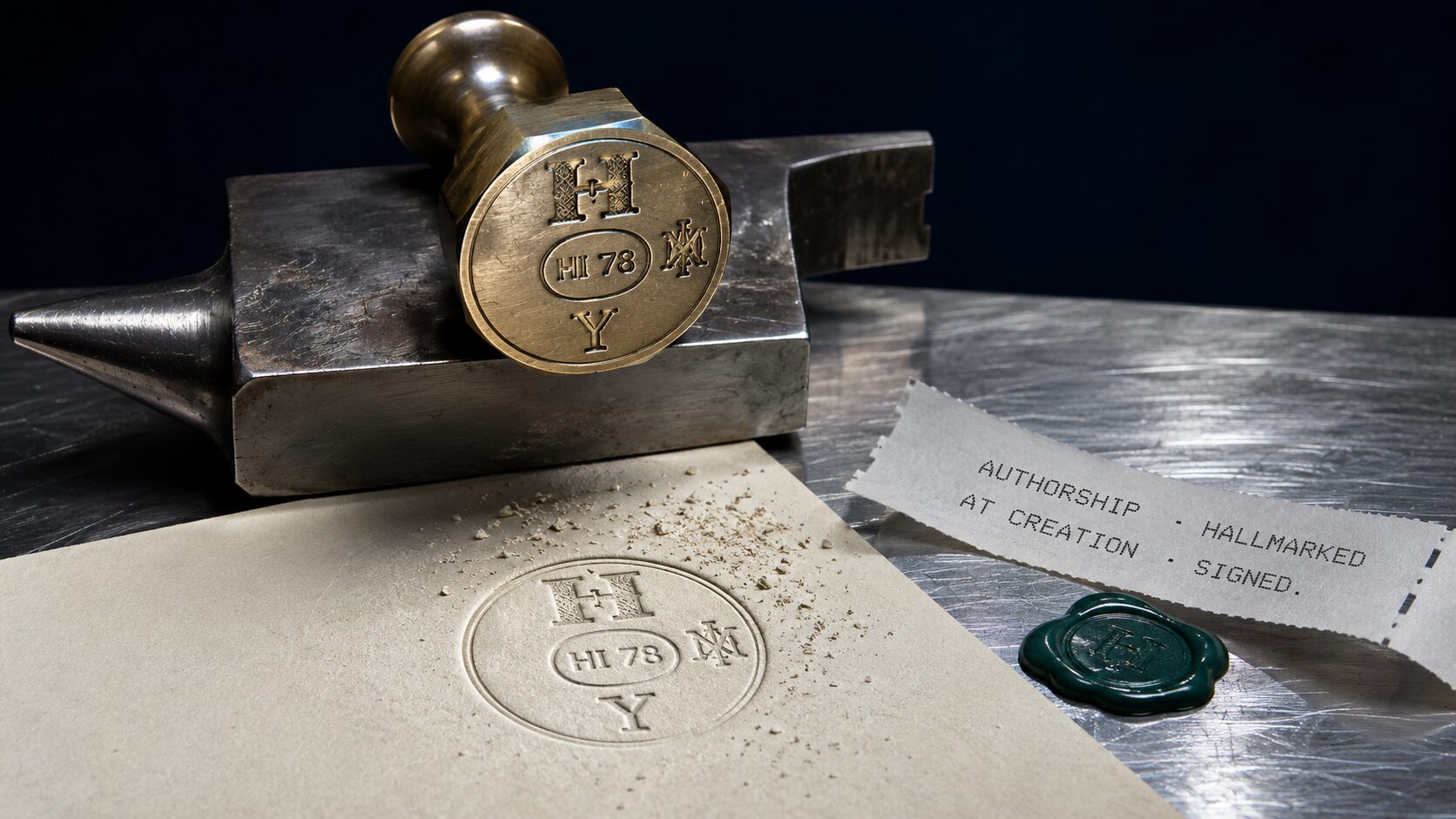
A vintage brass-and-steel hallmarking press on a brushed steel bench. An engraved hallmark stamp is being pressed into a sheet of paper, leaving a deep emerald mark with the HumanMark cryptogram. A signed cryptographic receipt emerges from the side of the press.
The hallmark · Stamped at creation · Travels with the work

Every other tool in this space is a guess. They take a piece of writing or a piece of art after the fact, run a model over it, and produce a probability. The guess is sometimes right and sometimes wrong, which is why teachers, publishers, and lawyers have stopped relying on the category. HumanMark is the opposite. It is a record, issued at birth, signed at the moment the work is made, and verifiable forever.

What HumanMark is

A record issued at the moment a piece of work is created.

You write, record, paint, film, or compose inside HumanMark. The kernel watches the work being made on your device. When you finish, it issues a signed certificate. The certificate is the badge. It travels with the work. Anyone can confirm it is real using the free verifier.

What HumanMark is not

It is not a detector. It cannot score work it never watched being made.

HumanMark does not look at a finished piece of writing or art and guess whether a human made it. That is the category that failed. HumanMark only certifies what it watched being created. No after-the-fact guess. No false-positive scandal on writing that does not fit a model's training distribution.

How a HumanMark certificate is born

Four steps from typing to signed badge.

HumanMark works the same way for every medium. It watches the work being made on your device. It records the cadence, the choices, the tools, the moments of editing. It signs the result. You get the badge. The work carries it.

1

You create

Open HumanMark on web, Mac, iOS, or as a browser extension. Write, record, paint, film, or compose. Your work never leaves your device.

2

HumanMark watches

The kernel observes the work as it is being made. Typing cadence for text. Recording session for audio. Brush strokes for visual art. Camera and edit trail for video. Citation timeline for academic work. The observation happens locally.

3

HumanMark signs

When you finish, the kernel signs the work cryptographically. The signature is the inseparable byproduct of the observation. It cannot be forged.

4

You get the badge

The Hi-score and the signed badge are issued together. Embed the badge anywhere your work appears. Anyone can verify it with the free verifier.

The Hi-score the scribe shows at the top of this page traces the proportion of human authorship signal in the work. Hi 78 means the spiral closes 78 percent of the way. Hi 94 closes 94 percent. The sparkle stops at the score. Score, animation, and badge are the same number.

What the badge looks like in the wild

The badge travels with the work.

A vintage notarial study. A leather-bound ledger lies open on a brass-railed walnut desk. A wax seal embossed with the HumanMark cryptogram sits beside a signed authorship certificate. A brass banker's lamp illuminates the scene. The notarial register reads HumanMark · Living Notary.
The living notary · Verifiable in the wild

HumanMark issues one badge per piece of created work. Creators choose where to display it. Publishers, platforms, and broadcasters that pay the Read License can verify and re-display it on the surfaces they control. A reader, listener, viewer, or reviewer sees the badge in context and clicks through to verify if they want to.

Substack post
Casey Wright · Personal Notes · 4 min read
What the August deadline actually means for newsroom workflows

If you have been reading the Article 50 coverage and still feel like the practical layer is missing, this is the piece. Here is the operational picture, the rough edges, and the questions your committee is going to ask first.

HumanMarkHi 94
News article byline
The Reporter — Technology
Inside the patent dispute reshaping AI provenance
Song page

Threshold

M. Hale · Single · 3:24

Released June 2, 2026 · HumanMarkHi 86
Academic paper
Journal of Cognitive Provenance
Creation-side attestation in regulated authorship contexts
R. Klein, S. Park, J. Adeyemi · Vol. 14, Iss. 3, July 2026
Abstract
A working framework for content authorship verification under the EU AI Act Article 50 human-editorial-control exemption, grounded in a creation-side attestation primitive.
HumanMarkHi 97
What HumanMark stops in the real world

Five harms the same architecture addresses on different surfaces.

A vintage forensic investigation room. A brass magnifying lens hovers over a fingerprint card on a brushed steel examination table. The fingerprint ridges glow faintly emerald with the HumanMark cryptogram woven into the pattern. Cabinet shelves behind hold leather-bound case files.
The signature beneath all five surfaces

HumanMark is one patent, one kernel, one signed receipt. The buyer changes per surface. The protection compounds for the people who need it most.

Dating

The premium tier becomes a verified-human-only space.

Romance and confidence-fraud scams reported to the U.S. Federal Trade Commission Consumer Sentinel network have exceeded $1 billion annually for multiple consecutive years. Profile copy and in-conversation messages composed inside HumanMark carry a Hi badge. AI-generated scammer profiles cannot produce one. Major dating-platform operators pay the Tier 1 Platform Read License; users see the badge on every verified profile and every verified message.

Scammer unit economics break. The premium tier becomes safe again.

Deployed when a major dating-platform operator signs the Tier 1 Read License.

Phone calls

You can answer your phone again.

The phone calls older family members have stopped answering are AI voice clones impersonating loved ones, Medicare officials, bank investigators, and the IRS. HumanMark verifies human authorship of voice content at the moment it is spoken on a verified device, through the hardware-rooted biometric liveness attestation tiering filed in the patent. Device makers and the major carriers pay the Tier 1 Read License. Real human callers carry a green verified badge in the dialer. Clone-voice scammers cannot.

The grandchildren callers are real. The scammers are flagged before pickup.

Deployed when the device or carrier platform signs the Tier 1 Read License.

Email

Your inbox becomes human again.

Phishing, fake invoices, fake delivery notifications, fake Medicare scams, and fake grandchild emergencies are the same single-vector attack. Email composed inside any major mail client is signed by HumanMark at send time. The recipient client verifies the signature on arrival. Unsigned email is sorted into a flagged folder. Major mail-client operators pay the Tier 1 Read License. The inbox becomes the verified channel it was supposed to be.

The messages from real humans get through. The scams get sorted out.

Deployed when the email platform signs the Tier 1 Read License.

Advertising

The feed becomes accountable.

A documented portion of major social-platform advertising is AI-generated fraud impersonating brands, products, and public figures. Large ad platforms that adopt the HumanMark Read License can require a verified badge on every ad before serving it. Real advertisers create real ads. Scammers cannot. The ad surface stops being the easy fraud channel it has become.

Ads in the feed are real ads from real advertisers.

Deployed when the ad platform signs the Tier 1 Read License.

Elder protection

Protection that compounds across surfaces.

The same elderly person targeted today through phone, email, advertising, and social messaging gets layered protection on every surface as the platforms embed HumanMark verification. The architecture is the same architecture on every surface. The protection compounds. The four surfaces above are the four scam vectors that hurt the people who deserve to be protected first. Each Tier 1 Read License that goes live across phone, email, ads, and dating closes a vector.

The people scammers prey on get the strongest verification first.

Deployed cumulatively as each platform signs.

Why one patent covers all of this

One kernel. Five surfaces. The same signed receipt.

HumanMark is creation-side attestation. The patent files the kernel and the bidirectional license architecture once. The medium changes (text, voice, image, video, code). The signature mechanism does not. Every Tier 1 platform that integrates the Read License protects every user on its surface from every adversary that cannot produce a verified badge. The buyer pays once. The protection runs everywhere.

One filing. Every surface. The architecture is the moat.

HumanMark Continuum™

One badge per piece. One verifiable trajectory across every revision.

HumanMark Index issues a certificate for a single piece of work. HumanMark Continuum tracks the authorship trajectory of a piece across every revision, edit, and editor. Each version is cryptographically signed, hash-chained, and independently verifiable. The forensic engine reports when human content was introduced, when AI content was introduced, by which editor, and at what rate. The Continuum engine runs today and is available institutionally now. Consumer integration into the Write Surface follows after the HumanMark Index launch.

Institutional license available today, from $25,000 per year. For publishers, schools, law firms, academic publishers, and editorial committees that integrate the Continuum engine directly. Patent pending. Counsel held under filing. Request the Continuum brief.

Get a license

Anyone can see the badge. Only licensed platforms can verify it.

HumanMark splits the license in two ways. Creators get the right to make work that carries a badge. Platforms, publishers, and broadcasters get the right to verify those badges cryptographically and display the result on their surfaces. The badge is free to look at. The verification is the licensed product. This is how the same kernel pays a $99 creator and a $2 million platform.

Tier License Annual Who it is for
1 Creator, individual from $99 A writer, journalist, academic, musician, artist, photographer, voice professional, or filmmaker who wants the badge on their own work. Self-serve credit card. Live at launch.
2 Creator, institutional from $5,000 Publishers, schools, studios, agencies, and ghostwriting collectives. Every staff creator gets a Write License. Volume-scoped.
3 Platform, mid-market from $50,000 Substack, mid-tier publisher CMS, blogging and music platforms, content marketplaces. Platforms embed verification into their product and display the badge to readers.
4 Platform, Tier 1 from $2,000,000 Major operating-system vendors, large search and social platforms, creative-tool publishers, large dating-platform operators, and frontier AI labs. The platforms whose surfaces reach hundreds of millions. Embedded at platform layer.
5 Per-event overage $0.001 / event High-volume platforms pay per certificate verified above their contracted volume band.
Common questions

The questions readers, journalists, and committees ask first.

Does HumanMark detect AI?

No. HumanMark does not look at finished work and guess whether a human made it. That is the category that failed. HumanMark is the opposite: it issues a certificate at the moment a piece of work is created, by watching the work being made on the creator's own device. The badge says, "this piece was authored inside HumanMark, here is the signed proof." No badge means HumanMark was not used. It does not mean the work is AI.

What does the Hi-score mean?

The Hi-score is the percentage of deliberate human authorship signal HumanMark observed while the work was being made. Hi 97 means almost the entire piece came from your typing, recording, painting, filming, or composing, with little or no help from an AI tool. Hi 78 means the work was mostly yours with some AI involvement (a research assist, a grammar fix, a chord suggestion). Hi 50 and below means a substantial portion of the work was machine-produced and the creator did not edit, accept, or reject the suggestions as a human author would.

The score is not a verdict. It is a record of how the work was made. Editors and readers decide what counts as enough.

Can I get a HumanMark badge on something I already wrote?

No. HumanMark is a creation-side certificate. It can only certify what it watched being made. If you wrote a piece in your favorite tool last week, HumanMark cannot retroactively certify it. That is the architectural choice that prevents the false-positive problem that has undermined every retrospective detector. To get a badge on your next piece, write or record it inside HumanMark from the start.

Does HumanMark see what I am writing?

No. The HumanMark kernel runs on your own device. Nothing you type, record, or compose leaves your device. The kernel observes the cadence and the choices of your authorship and signs the result. The signature is what travels, not the content. Your work is yours, the proof is portable.

How does a reader confirm a badge is real?

Every HumanMark badge links to the free open-source verifier on GitHub. Click the badge or run the verifier directly. The verifier takes the badge and the content and returns "valid" or "invalid." No HumanMark server is involved. The cryptography is the only thing that confirms the badge. The verifier is published under MIT.

What surfaces does HumanMark work on?

Web, Mac, iOS, and browser extensions for Chrome, Firefox, and Safari at launch. Native partner integrations for music DAWs (Logic, Ableton, Pro Tools), visual art tools (Procreate, Photoshop), and video editors (DaVinci Resolve, Premiere) ship in Phase 2. The kernel is medium-agnostic. The patent covers text, music, voice, visual art, video, code, photography, and academic work.

Why is the badge a license and not a free public service?

The badge is free to display and free for anyone to look at. The cryptographic verification, the part that proves the badge is real and not a copy, is licensed to platforms and institutions that build verification into their products. Creators pay $99 a year to issue badges on their own work. Platforms pay more, because they reach more readers. This split is filed in the patent. It is what makes the same kernel pay a solo writer and a global platform without one cannibalizing the other.

How does HumanMark fit the EU AI Act?

EU AI Act Article 50 starts enforcement on August 2, 2026 with penalties up to €15M or three percent of global turnover. Article 50(3) carries a human-editorial-control exemption that turns on demonstrable provenance. HumanMark produces the auditable provenance record the exemption requires. A publisher or platform that embeds HumanMark can rely on the badge as evidence of human editorial control on a per-piece basis. The same logic applies to U.S. NIST AI RMF, California SB 942, and the Texas SCOPE Act.

What is HumanMark Continuum?

HumanMark Index issues one certificate per piece of work. HumanMark Continuum tracks the authorship trajectory of a single artifact across every revision. Each version of the work is cryptographically signed and hash-chained. The forensic analysis engine reports when human content was introduced, when AI content was introduced, by which editor, at what rate, and the net change in the HumanMark score from origin to current state. A regulator, editor, or auditor reading a Continuum trajectory can independently verify the chain and the analysis without contacting the operator.

The Continuum engine runs today and is available institutionally now. The architecture includes a privacy-by-default property where raw content is never persisted to the trajectory ledger, which protects attorney work product, peer-review drafts, and confidential authorship in regulated settings. Available as an institutional license from $25,000 per year. Consumer integration into the Write Surface follows after the HumanMark Index launch. Patent pending. Counsel held under filing.

Who is behind HumanMark?

HumanMark is part of the Regulayer patent estate. Patent pending. Counsel held under filing. Specific application identifiers are held under attorney-client privilege.

Three ways in

Pick the door that fits.

Individual creator

$99 / year

Create text, music, voice, art, video, code, or academic work inside HumanMark. Every piece gets a signed badge. Self-serve credit card. Live at launch.

Start the Write License

Institutional

from $5,000 / year

Publishers, schools, agencies, studios. Every staff creator gets a Write License. Volume-scoped per seat. Contact for institutional onboarding.

Contact for institutional

Platform

from $50,000 / year

Platforms that embed verification commercially. Mid-market and Tier 1 platforms. Diligence routed through counsel.

Route through counsel