
Why now
A world where every AI action and every human creation carries proof you can check, built before the dispute, not after.
Billions pour into foundational models at the top. The applied markets, pharma, finance, law, wait at the bottom. And nothing flows through the middle, because no one will act on the output of a model no one can account for.
You would not take a drug an ungoverned AI designed. A bank will not run a model it cannot account for. A court will not accept a record it cannot verify. The world refuses what it cannot prove, and that refusal is the pinch. Regulayer is what opens it: governance and proof at the moment of inference, so value can finally flow from the investment above to the markets below.
There is more control over making a candy bar than over the foundational model that designs a drug.
The downstream is regulated to the hilt: manufacturing rules, records rules, Fort Knox. But the upstream, where the AI actually makes the decision, is left wide open. And a bad decision, governed perfectly downstream, is still a bad decision. The leverage is upstream, at inference, the discipline now being named inference-time governance. We filed on it in April 2025, before it had a name. That is the ground our filings cover, and where proof changes the outcome.
Two kinds of pressure converge in the same window. The laws set the deadline. The harms are the reason.
Laws change. The harms don't. Every week hands you a fresh one. That is why the moment is now, and why the category is permanent.
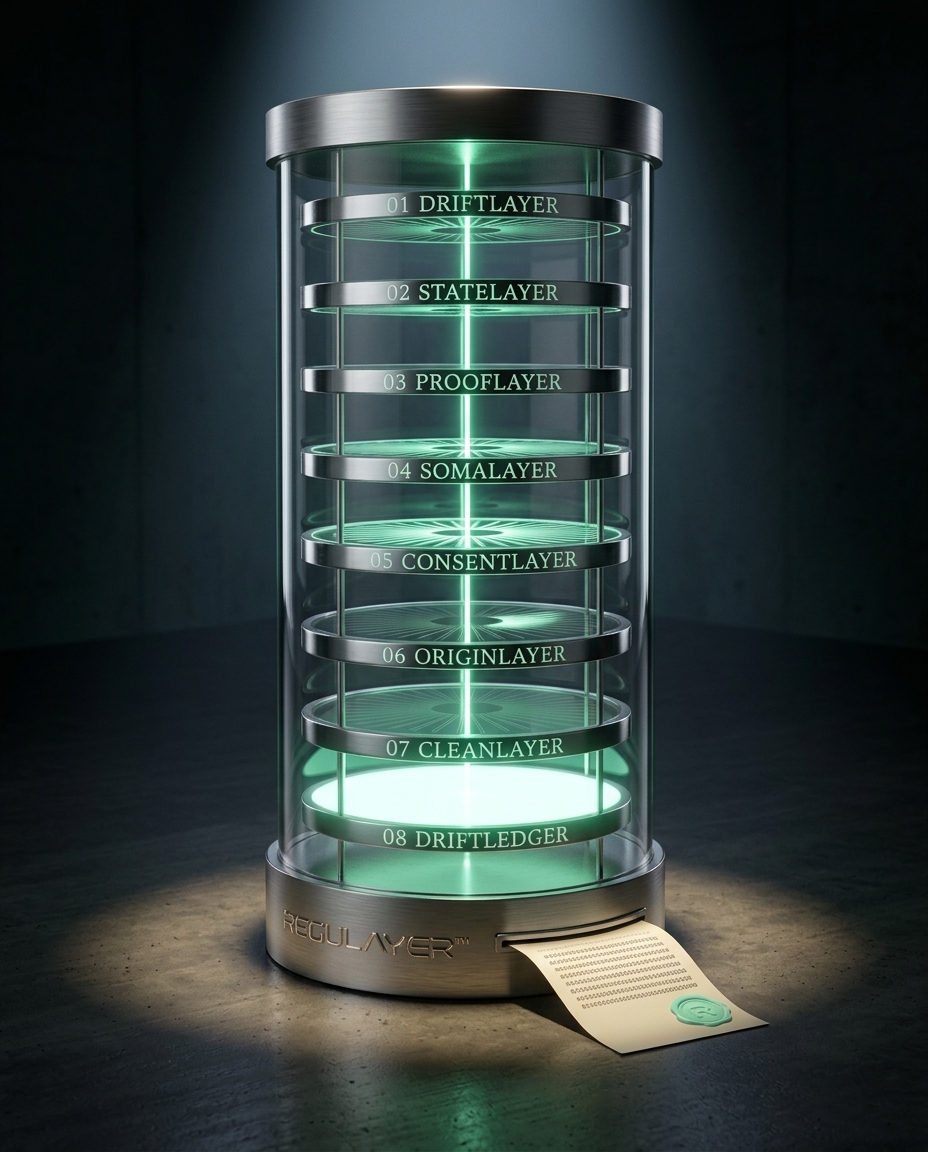
The whole of it, govern the action, contain the drift, sign the proof, runs in a single lightweight component on ordinary hardware, with no outbound call by design.
Here is the point: intelligence does not require infrastructure. The thing that makes AI trustworthy is not more cloud, it is a proof layer thin enough to ride anywhere the model already runs, in the cloud or on the device, and sealed so your data never has to leave. It does not replace the stack. It completes it, and makes everything built on it adoptable in the places that could not say yes before.
The people building the most capable AI now say it plainly: there is a gas pedal, and no brake.
And when safety is added, it is usually built inside the model, where the same system being governed can switch it off, or be talked around it. A brake that works has to sit somewhere the model cannot reach.
It cannot be switched off by the thing it governs. It fails toward stop, so failure or silence halts the action rather than letting it through. And it keeps a signed record anyone can verify. That is the layer we filed, and the layer this moment is asking for.
Every aircraft carries a black box, so that whatever happens, there is a record no one can argue with. Regulayer puts one inside your AI.
A brake, so it stops before it goes wrong. A black box, so it can prove what it did.
At the moment of inference, on the machine, with proof. Not post-hoc detection in the cloud.
Proof, not promises, for everything AI touches.