
For humans who create
Not a guess. Not a detector. A record, made at creation.
Put your mark on something you made, the moment you make it. A poem, a song, an idea, an agreement, a message that mattered. Today it works on the words you write, and it grows to cover voice, art, photography, film, and presence, proven live.
A specimen mark, with sample data. Tap it to watch again.
Like a birth certificate, it records who made something, and when. It is proof of authorship that you hold and anyone can check, not a certificate of compliance with anything.
The badge travels with the work, and anyone can check it, free.
Every other tool guesses. It reads finished work, runs a model, and returns a probability that is sometimes right and sometimes wrong.
HumanMark is the opposite. It records the work as you make it, on your own device, and signs the result. A record issued at creation, and verifiable for as long as the work exists. It is built for the people detectors let down: teachers, publishers, and the evidentiary standards courts apply.
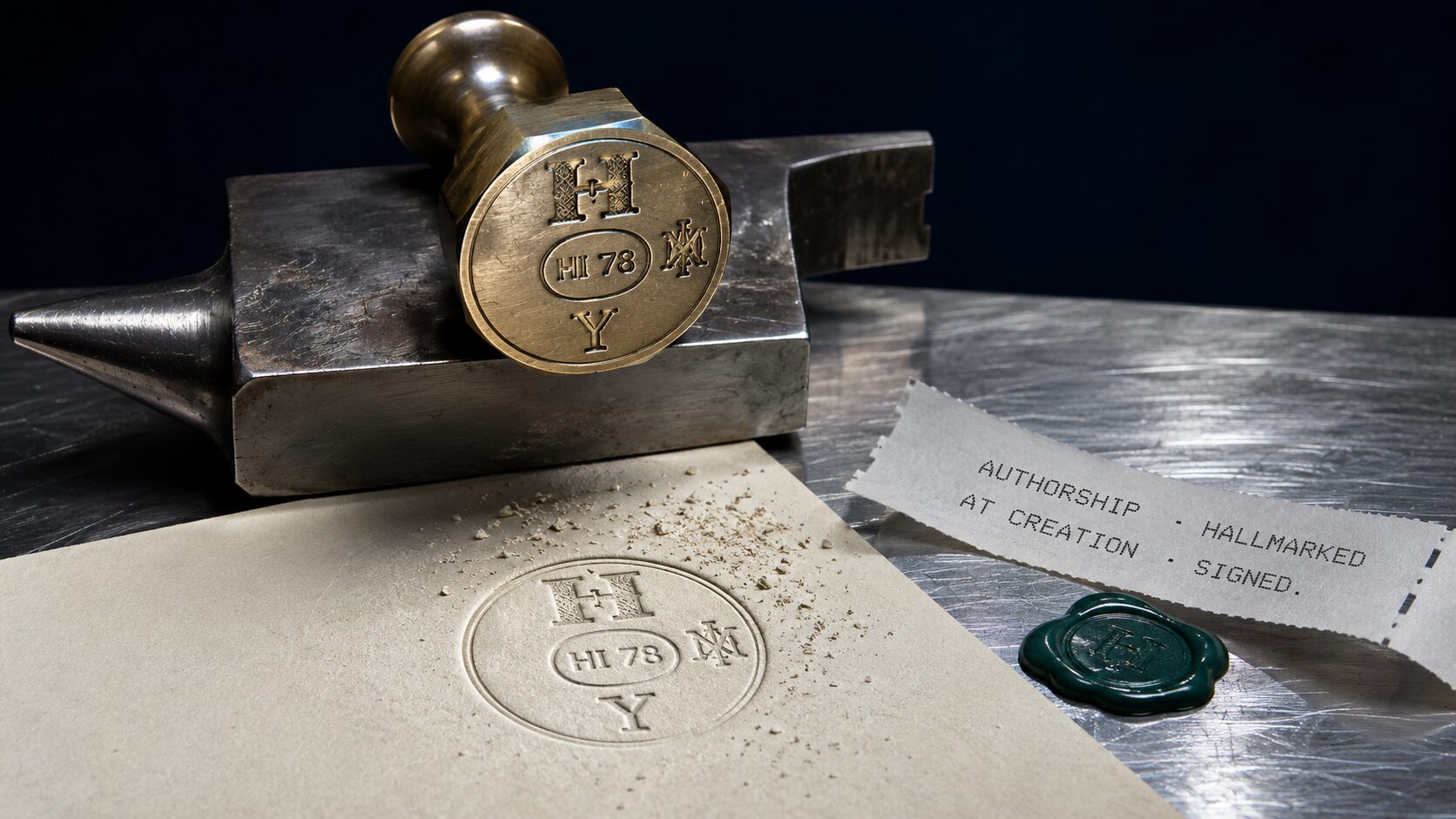
What it is, and what it isn't.
A signed record, issued the moment a piece is made.
You write inside HumanMark. It records how the work is made, and when you finish it issues a signed badge that travels with the work. Anyone can confirm it with the free verifier.
It is not a detector. It cannot score work it never watched being made. No after-the-fact guess, and no false alarm on writing that does not fit a model's idea of human.
From typing to signed badge.
What this stops in the real world
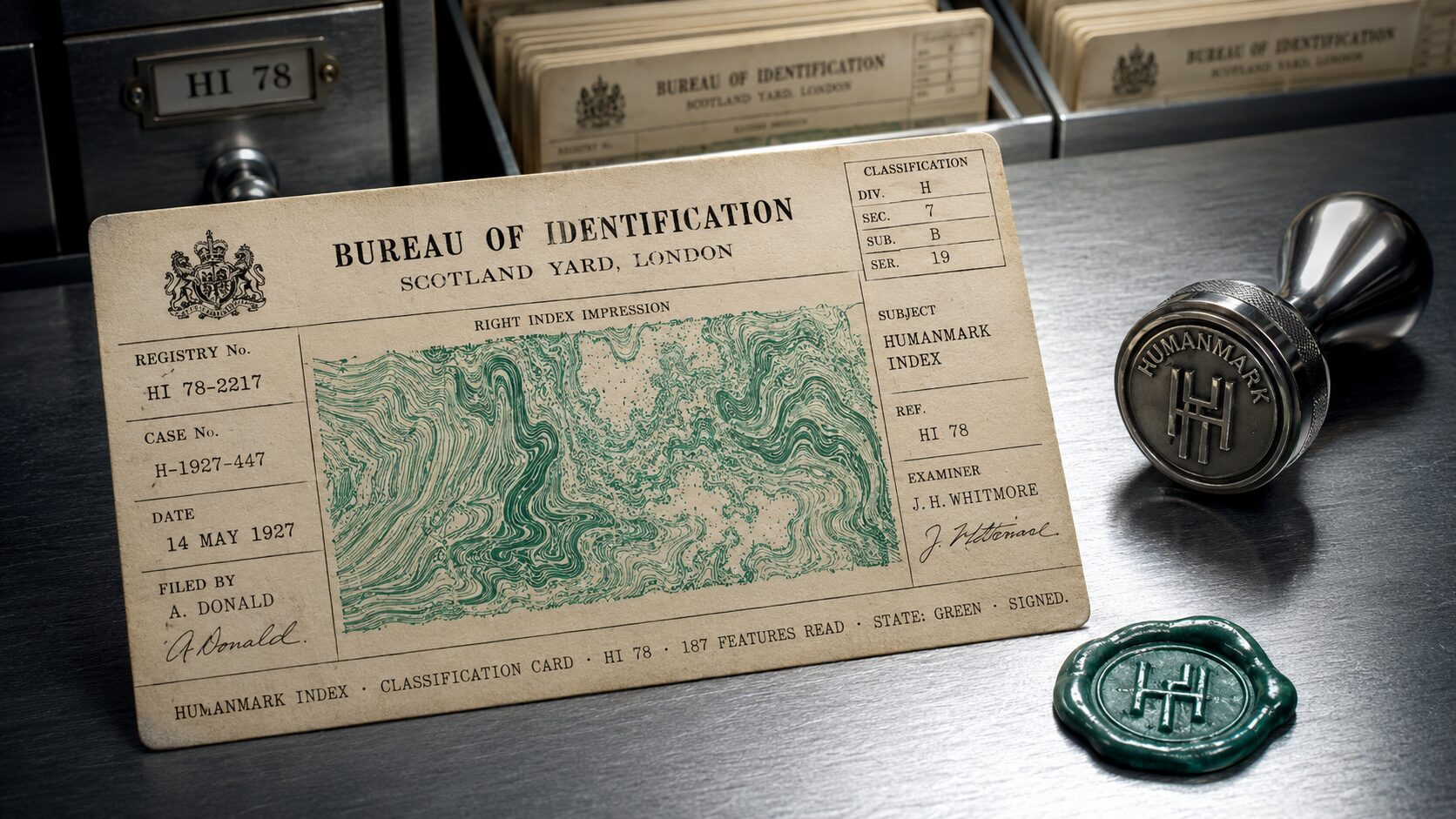
The signature beneath all five surfaces.
Dating
The premium tier becomes a verified-human space.
Romance and confidence-fraud scams reported to the U.S. Federal Trade Commission have exceeded $1 billion annually for multiple consecutive years. Profiles and messages composed inside HumanMark carry a badge. An AI-generated scammer profile cannot produce one.
Scammer unit economics break. The premium tier becomes safe again.
Phone calls
You can answer your phone again.
The calls older family members have stopped answering are AI voice clones impersonating loved ones, banks, and Medicare. HumanMark verifies a human is speaking on a verified device, through the biometric liveness attestation filed in the patent. As carriers connect, real callers carry the badge in the dialer. A cloned voice cannot.
The grandchildren calling are real. The clones get flagged before pickup.
Your inbox becomes human again.
Phishing, fake invoices, fake delivery notices, and fake family emergencies are one attack. As mail providers connect, a message authored by a person is signed at send and verified on arrival. The unsigned message sorts into a flagged folder.
Messages from real humans get through. The scams get sorted out.
Advertising
The feed becomes accountable.
A documented share of platform advertising is AI-generated fraud impersonating brands and public figures. A platform can require a verified badge before serving an ad. Real advertisers make real ads. Impersonators cannot.
Ads in the feed are real ads from real advertisers.
Elder protection
Protection that compounds across surfaces.
The same person is targeted through phone, email, ads, and messaging. As each surface adopts the badge, the protection layers. The same architecture, everywhere, protecting the people scammers prey on first.
The strongest verification reaches the most targeted people first.
Why one filing covers all of this
One kernel. Five surfaces. The same signed record.
HumanMark is creation-side attestation, filed once. The medium changes, text, voice, image, video, code. The signature mechanism does not. Every surface that adopts it protects every person on that surface from every adversary that cannot produce a badge.
One filing. Every surface. The architecture is the moat.
One stroke, drawn while you watch. Hi 78 means the stroke closes 78 percent of the way. Hi 94 closes 94 percent. Score, animation, and badge are the same number. And every score reads in plain words too: Hi 78 is human-led, AI-assisted. How much of the work was you, made visible.
The HumanMark Index runs from 0 to 100, the share of human authorship it watched. 97 is almost entirely your hand. 78 is mostly yours, with some help, a research assist, a grammar fix. 50 and below means the machine did much of the work. It is a record of how the work was made, not a verdict. Editors and readers decide what counts as enough.
And every badge also reads in plain words, in the five bands filed in the patent: almost entirely human, human-led with AI assist, collaborative, AI-generated with light edits, machine. The number is the count it watched. The band is the attestation.
One kernel, one mark, every medium. Anywhere there is a creation tool to connect to, the mark can be made there. The words you write carry the mark today. Every other surface is filed in the patent and goes live as each platform connects.
And it does not need the internet. The work is watched and the record is signed on your own device, and the badge checks offline, in any browser. A connection is needed to install, and only when the tool you create in lives online itself.
The Index marks a single piece of work. The Continuum tracks its authorship across every revision: each version signed, hash-chained, and independently verifiable. It reports how the human and AI mix changed from draft to draft, and it never stores your content, which is what protects attorney work product, peer-review drafts, and confidential authorship. The engine runs today, available to institutions now. Request the Continuum brief.
The questions people ask first.
No. It does not look at finished work and guess. It issues a record at the moment a piece is made, by watching it being made on your device. No badge does not mean the work is AI. It means HumanMark was not used.
The share of deliberate human authorship it watched. 97 means almost the entire piece came from your hand. 78 means mostly yours with some AI help. 50 and below means the machine produced much of it. The score is a record, not a verdict. Editors and readers decide what counts as enough.
No. It can only record what it watched being made. Write or record your next piece inside HumanMark from the start. That is the choice that avoids the false alarms every retrospective detector suffers.
No. Your content never leaves your device. It records your authorship locally, and only a compact record is sent to issue the signature. The work is yours. The proof is portable.
On the author's own device, with the same fingerprint or face unlock the device already uses. The biometric never leaves the device and is never stored by HumanMark. What travels is the signed statement that a live, attested person was present when the work was made. This tiered liveness attestation is filed in the patent.
Every badge links to a free verifier that runs in the browser. It takes the badge and the content and returns valid or invalid. No HumanMark server is involved. The cryptography is the only thing that confirms it.
Article 50 enforcement begins August 2, 2026, with penalties up to fifteen million euros or three percent of global turnover, and its human-editorial-control exemption turns on demonstrable provenance. HumanMark produces the auditable, per-piece provenance record that the exemption asks for. The same logic serves the NIST AI framework and the U.S. state provenance laws.
Made by a human. Provable by anyone.