regulayer.com
Heartbeat Attested
EU AI Act Article 50 enforcement begins
··· days until August 2, 2026

Prove the AI.
At every output.

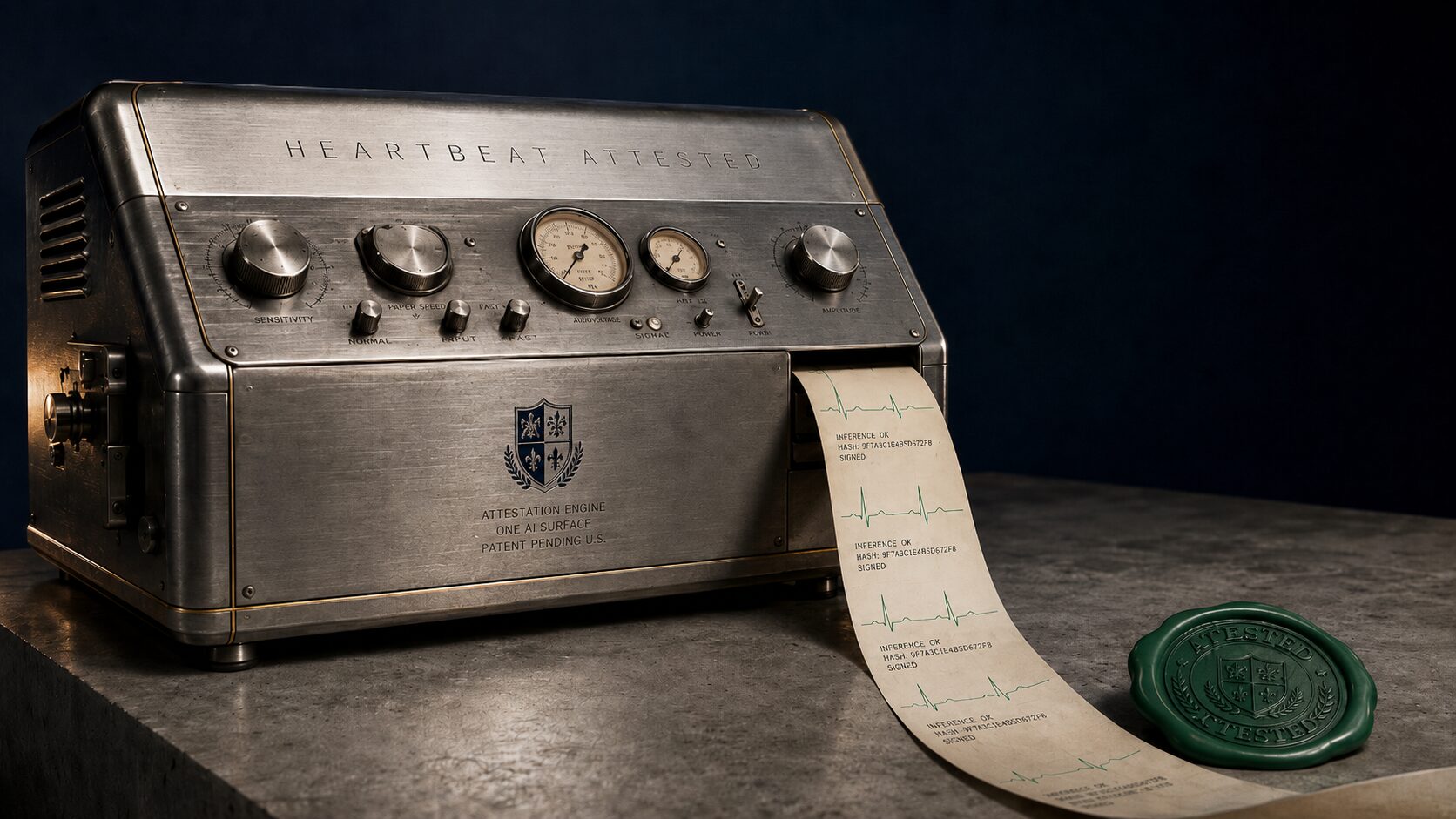
A doctor takes the pulse before reading the chart. Heartbeat Attested™ is the pulse layer for one AI deployment. It signs every output. Each governed decision produces a signed receipt. The receipts hash-chain into an audit ledger that any auditor can verify without contacting us. When the AI behaves correctly, the pulse is steady. When it drifts, the pulse changes, the receipts show it, the ledger keeps the record. Runs where the data lives. Never pings out.

Entry license from $40,000/year per AI surface. Patent pending. Independent verifier on GitHub.
Heartbeat Attested · Pulse steady
Continuously attested
Deployment your-deployment-01
Attested since license activation · last heartbeat just now
Kernel state: ALIVE
Auditors verify this badge themselves. No contact with us required.
One pulse · One chain · One proof

Audio plays muted by default. Click the speaker icon to hear the 60 BPM pulse.

Patent-pending technology · Counsel held under filing

The math closes the deal.

A worked example for a mid-sized AI vendor with European customers. Replace the revenue figure with your own. The conclusion does not change.

Without Heartbeat Attested™

Maximum Article 50 exposure

€4,500,000

Three percent of €150M in global annual turnover. Per violation. The EU AI Office can issue compounding penalties for ongoing non-compliance. Your audit logs sit on a server you administer, which means you cannot prove the logs are contemporaneous.

With Heartbeat Attested™

Annual license

$40,000

One-time prepay. Twelve months of continuously signed, hash-chained evidence streams that any auditor verifies with an open-source script. Producing defensible evidence costs a rounding error against the exposure you already carry. The license buys the evidence, not a guarantee about the fine.

The world has already ruled on AI without proof.

Three real cases from public court records and regulatory action. Each one shows what happens when AI is deployed without verifiable governance evidence, and what Heartbeat Attested™ would have done if it had been in the chain.

United States v. Heppner · SDNY, February 2026

Attorney-client privilege waived through AI servers

A federal court held that attorney-client privilege can be waived when confidential client data passes through third-party AI servers. The defending firm could not produce evidence that the AI use was governed, scoped, or contained. The privilege determination turned on what could not be proven about the AI interaction.

→ Heartbeat Attested™ signs every governed AI output locally. The receipt is the evidence that the interaction was scoped and contained. The architecture leaves no trace because nothing pinged out.
UnitedHealth · nH Predict litigation

AI-driven claims denials at scale

An AI-driven claims-decision system has been alleged in litigation to have produced denials at scale with a high error rate, with downstream harm to patients. The complaint cites the absence of a verifiable audit artifact for each AI-assisted decision and the difficulty of reconstructing what the system did at the moment of each denial.

→ Per-decision signed receipts give every AI-assisted decision an audit artifact. Reviewers, regulators, and counsel verify the chain themselves. Evidence is produced as a by-product of governance, not assembled after the fact.
Italian Garante v. Replika · 2023

Emergency ban on AI companion for minors

Italy's data protection authority issued an emergency processing ban on Replika in February 2023 after determining it failed to protect minors from harmful content. No verifiable evidence of age-adaptive governance existed at the time of the regulator's review.

→ Heartbeat Attested™ provides age-adaptive enforcement evidence on demand. The regulator inspects the signed stream directly. Nothing about the architecture asks them to trust the operator's word.

One pulse layer. Five surfaces. Same signed receipt.

The architecture does not care what the AI is doing. It cares that every governed output produces an evidence beat. Five buyers, five regulatory anchors, one license shape.

Privileged legal AI

The pulse runs inside the firm.

Surface: one major legal-AI or productivity-AI deployment inside a mid-size firm.
Massachusetts BBO guidance on AI in legal practice. ABA Model Rules 1.1 and 1.6. The privilege-waiver risk recognized in United States v. Heppner.
Every prompt and every output gets a pulse reading. Privilege survives because the receipts prove the interaction was scoped and contained, locally, with nothing pinging out.
Biotech drug discovery

The pulse runs inside the validated environment.

Surface: one AI assistant inside a GxP-validated computerized system.
21 CFR Part 11 audit-trail requirements. EU GMP Annex 11 for computerised systems. FDA-EMA Joint Principles 2026, Principle 9 on continuous auditability of AI in regulated drug development.
Every AI-assisted decision is a signed beat with a verifiable timestamp. Inspectors verify the chain themselves. The validated environment stays validated because the evidence is produced inside it.
Semiconductor traceability

The pulse never crosses the wire.

Surface: one design-assistant AI inside an export-controlled environment.
US export control regulations on AI-assisted design transfer. ITAR and EAR scoping of controlled technical data. National security review of AI used inside the controlled boundary.
Every governed output stays inside the controlled boundary. The receipt is the evidence that the controlled material was never disclosed. The verifier confirms it without ever seeing the underlying content.
Contamination control

The pulse reconstructs the event.

Surface: one AI tool advising on environmental monitoring or release decisions inside a cleanroom or bio-manufacturing operation.
GMP cleanroom standards. ISO 14644 series for cleanroom evidence. Regulatory expectation that any AI-assisted release decision is reconstructable from contemporaneous record.
When a contamination event is investigated, the chain is the record. Every AI-assisted decision is a beat the investigator can replay. The audit ledger does not depend on memory or on the operator's word.
Cross-vertical Article 50

The pulse meets the August 2 cliff.

Surface: one consumer-facing AI tool serving European users.
EU AI Act Article 50 on transparency for AI systems interacting with humans. Article 52 on synthetic-content disclosure. Penalty ceiling of three percent of global turnover.
The article requires transparency that auditors can verify. The pulse layer produces the evidence as a byproduct of governance, not a report written later. Responsive at the moment a regulator asks.
One license, five surfaces

The architecture is the moat.

Same kernel. Five buyers. Five regulatory anchors. One license shape.
The license does not change with the vertical. The pulse layer is surface-agnostic by design. The patent-pending architecture covers any deployment that needs to produce verifiable evidence at the moment of output.
If your AI surface is not in the five above, the architecture still fits. The conversation moves from category recognition to surface scoping.

How the proof layer works.

Three steps, one architecture. The kernel runs where the data lives. It never pings out. The receipt is produced as a by-product of governance, not a report someone writes after the fact.

Step 1 · Govern at the moment of output

The kernel runs locally.

docker compose up deploys the governance kernel inside your environment, bound to your license file. Every AI output passes through it. The decision (allow, refuse, halt, escalate) is made on local computation alone. The capability is local or it does not run in that session.

Step 2 · Issue the receipt as a by-product

Signed and chained, where the data lives.

Each governance event produces a cryptographically signed receipt, hash-chained to the previous one. Tamper-evident, append-only, signed on your machine with material generated there. Nothing pings out. Nothing leaves. The receipt is real because nothing ever did.

Step 3 · Hand the proof to whoever asks

Independently verifiable, without us.

Export the bundle. Your auditor, counsel, or regulator runs the open-source verifier against your public key. The chain either matches or it doesn't. Verification is a property of the cryptography. You never call us. We never see your data. Proof you can hold, made where the data lives, sent nowhere.

Anyone can verify it. Without us.

The verifier is open-source under the MIT License. Python standard library plus the cryptography package. No network calls. No telemetry. The same script that ships inside every evidence package is also public, so an auditor can fetch it independently and confirm byte-identical.

An auditor's terminal, replayed live.
$ pip install cryptography → installed
$ curl -O https://github.com/regulayer/regulayer-verifier/raw/main/verify_package.py
$ python verify_package.py ./evidence_package/
 
============================================================
Heartbeat Attested package verification
------------------------------------------------------------
Receipts read: 0
Valid signatures: 0
Hash chain head match: PASS
Bundle signature: PASS
------------------------------------------------------------
RESULT: PASS
============================================================
$
That output is the auditor's defensible answer. Open-source under MIT. No signup, no contact with us, no telemetry. The verifier runs offline against your public key and the audit ledger. Independence of verification is a load-bearing element of the patent-pending architecture.

Article 50 is the loudest cliff. Not the only one.

The same Heartbeat Attested™ evidence stream is responsive to the regulatory cascade behind Article 50. The lite tier is Article 50-scoped. Multi-framework coverage lives in the Enterprise tier.

Aug 2, 2026
EU AI Act Article 50
Transparency for AI systems interacting with humans. Penalty ceiling: €15M or 3% global turnover.
Aug 2, 2026
EU AI Act Article 52
Synthetic content disclosure. Marked-output requirements.
Dec 2, 2027
EU AI Act Articles 9, 14, 15
High-risk systems. Extended by the May 2026 Omnibus, still coming.
Active
NIST AI Risk Management Framework
Voluntary in the US. Federal-procurement preference.
Active
21 CFR Part 11
FDA electronic-records and audit-trail requirements.
Active
EU GMP Annex 11
Computerised systems in GxP-regulated pharma.
Active
FDA-EMA Joint Principles 2026 · Principle 9
Continuous auditability of AI in regulated drug development.
Active
ISO/IEC 42001
AI management systems. Audit-ready since late 2024.
Feb 2026
Colorado AI Act
Algorithmic discrimination in consequential decisions. Full enforcement 2027.
Active
NYDFS AI guidance
Financial services AI in New York. Effective late 2025.
Active
China Generative AI Service Management
Already in force. Provider obligations and content responsibility.
May 2025
Massachusetts BBO guidance
AI in legal practice. Plus ABA Model Rules 1.1 and 1.6.

Pricing: a ladder, not a flat number.

The unit is one AI surface, one stable identifier, like one major legal-AI deployment, one major productivity-suite AI tenant, one foundation-model enterprise endpoint, one internal RAG. The rung is set by the number of attested operators inside that surface. Locate yourself; the rung that fits is the rung you discuss with us.

Mid, department
$80,000 / year
11 to 50 attested operators on one AI surface
  • Everything in the entry tier
  • Multi-operator identifier tagging per receipt
  • Operator-level evidence rollup in the audit package
  • Same single-surface scope, same install, same docs
Book a conversation
Ceiling, surface scale
Above 50 operators
or multiple surfaces
This product is scoped to a single AI surface. Above this rung, the enterprise product is the rational choice.
  • Fleet view across surfaces
  • Drift-aware audit posture
  • Multi-jurisdiction evidence routing
  • The broader governance layer the entry tier does not include
Talk to us about enterprise

The license buys the evidence, not a guarantee about the fine.

Procurement and security review run on their own timeline regardless of where a buyer starts on the ladder. The conversation is where the verifier is demonstrated live against your environment, the license language is reviewed, and the right rung is confirmed.

Pick the cliff. Add the bundle.

Twelve regulation-specific deliverable packs. Each one attaches to any Heartbeat Attested™ tier. The premium adds to your base tier price. Every bundle ships with the standing disclosure.

Standing disclosure on every bundle

This guide helps you prepare for the named regulation. It does not certify your compliance. You remain responsible for your specific deployment. Where regulatory ambiguity exists or your situation has facts that affect the legal analysis, consult your own counsel for your specific deployment. Heartbeat Attested™ is infrastructure, not a certifier.

EU AI Act · Article 50

Transparency for AI interacting with humans.

Aug 2, 2026 Up to 3% global turnover
$50,000/year, on top of tier

Covers AI systems interacting with natural persons, generating synthetic content, or performing emotion or biometric categorisation.

What ships in this bundle
  • Deployment-design guide mapped to Article 50(1) through (4)
  • Provider versus deployer obligation matrix
  • Content marking template for synthetic outputs
  • Declaration of conformity template
  • Audit-prep checklist for EU AI Office inquiry
Get the bundle preview
EU AI Act · High-Risk (Arts 9, 14, 15)

Risk management, oversight, robustness.

Aug 2, 2026 / 2027 Up to 3% turnover or €15M
$50,000/year, on top of tier

For Annex III high-risk AI systems across the regulated categories.

What ships in this bundle
  • Risk-management documentation template (Article 9)
  • Human-oversight policy template (Article 14)
  • Accuracy and robustness test plan (Article 15)
  • Cybersecurity incident-response runbook
  • Annex III category mapping worksheet
Get the bundle preview
Colorado SB 24-205

Algorithmic discrimination in consequential decisions.

Feb 1, 2026 AG enforcement, CCPA penalties
$20,000/year, on top of tier

High-risk AI making decisions in employment, education, financial services, healthcare, housing, insurance, and essential government services.

What ships in this bundle
  • Deployer impact-assessment template
  • Consumer-notification language
  • Anti-discrimination testing plan
  • Colorado AG enforcement audit-prep checklist
Get the bundle preview
NYC Local Law 144 · AEDT

Automated employment decision bias audit.

In force $375-$1,500 per violation, per candidate, per day
$10,000/year, on top of tier

NYC employers and employment agencies using automated employment decision tools must conduct annual independent bias audits and notify candidates.

What ships in this bundle
  • AEDT inventory template
  • Bias audit data-format specification per DCWP rules
  • Candidate notice template
  • Annual audit summary template, publishable on the employer site
Get the bundle preview
California AB 2013

Training data transparency.

Jan 1, 2026 AG civil penalties
$15,000/year, on top of tier

California requires generative AI developers serving California persons to post training-data documentation.

What ships in this bundle
  • Training-data documentation template aligned to required disclosures
  • Posting checklist for the customer-facing disclosure
  • Internal data-provenance tracking specification
Get the bundle preview
NAIC AI Model Bulletin

AI Systems Program for insurers.

Rolling state adoption State DOI exam, license risk
$15,000/year, on top of tier

Insurers using AI in underwriting, rating, marketing, fraud detection, and claims must maintain a written AI Systems Program.

What ships in this bundle
  • AIS Program template
  • Third-party AI vendor management checklist
  • Examination-ready evidence pack template
  • Per-state adoption reference: CT, NH, IL, VT, MD, WA, AK, KY, PA, RI, NV
Get the bundle preview
SR 11-7 / OCC 2011-12

Model risk management for US banks.

In force OCC consent orders, capital add-ons
$50,000/year, on top of tier

US banks deploying AI or ML models for credit, market, operational, compliance, or capital decisions must manage model risk across the lifecycle.

What ships in this bundle
  • Model inventory template aligned to Section V expectations
  • Validation documentation template (Section IV)
  • Examination-ready evidence pack supporting ongoing monitoring
  • Development standards reference (Section III)
Get the bundle preview
FDA 21 CFR Part 11

Electronic records and signatures.

In force FDA warning letters, consent decrees
$30,000/year, on top of tier

FDA-regulated entities using AI in workflows producing records subject to FDA inspection.

What ships in this bundle
  • Part 11 control inventory template
  • Audit-trail design specification
  • Signature and record linking documentation
  • FDA-inspection-ready evidence pack
Get the bundle preview
EU GMP Annex 11

Computerised systems in GMP.

In force EMA enforcement, market authorisation risk
$30,000/year, on top of tier

EU pharma manufacturers using AI in GMP-regulated computerised systems.

What ships in this bundle
  • Validation plan template
  • Electronic signature control documentation
  • Periodic evaluation framework
  • Computerised systems inventory ready for EU inspection
Get the bundle preview
FDA GMLP

Good Machine Learning Practice for medical AI.

In force FDA enforcement, recall risk
$30,000/year, on top of tier

Manufacturers of AI or ML-enabled medical devices applying the GMLP Guiding Principles.

What ships in this bundle
  • GMLP-aligned development documentation template
  • Dataset characterisation framework
  • Model performance monitoring plan
  • Predetermined Change Control Plan template, FDA pre-market ready
Get the bundle preview
NIST AI Risk Management Framework

Federal procurement alignment.

Voluntary, federal converging Procurement disqualification
$25,000/year, on top of tier

Federal contractors and federal AI buyers requiring alignment to the NIST AI RMF and the Generative AI Profile.

What ships in this bundle
  • AI RMF crosswalk of your kernel deployment
  • Govern function policy template
  • Map function risk register template
  • Measure function metrics specification
  • Manage function ongoing-monitoring runbook
Get the bundle preview
Texas TRAIGA · Watchlist

Texas Responsible AI Governance Act.

Pending enactment Liability TBD
$15,000/year, on top of tier

Watchlist bundle. Texas Responsible AI Governance Act is pending in the legislature. Preparation framework mapped to the most recent publicly available bill text; any enacted statute supersedes.

What ships when enacted
  • Preparation framework mapped to current bill text
  • Notification when the statute is signed and the bundle is revised
  • Locked premium price held for everyone on the watchlist
Get the bundle preview

What Heartbeat Attested™ is, and what it isn't.

This product does one thing completely: it proves one AI deployment is governed. Read both columns so the boundary is clear before you buy.

What you get

  • One container-packaged governance kernel, deployed locally.
  • One signed receipt stream from one stable AI deployment.
  • An independent open-source verifier any auditor can run.
  • Evidence-package generator for Article 50.
  • A documentation pack written for self-install.
  • A license file, delivered by email within minutes of purchase.

What you do not get

  • A compliance certification. We do not certify. You produce evidence; you and your auditor interpret it.
  • Coverage for AI deployments beyond the one this license is bound to.
  • Fleet-wide views, drift monitoring, predictive analytics, or meta-governance. Those live in Regulayer™.
  • A consulting engagement, an SLA, or a support contract. The product is software.

Questions buyers actually ask.

What counts as one AI surface?

One AI surface is one stable identifier: one major legal-AI deployment, one major productivity-suite AI tenant, one foundation-model enterprise endpoint, one internal RAG, one customer-facing chatbot, one drug-discovery AI assistant, one semiconductor-traceability AI. The container kernel binds to that single deployment identifier and signs every governance event from it. If your organization runs three separate AI surfaces, you need three licenses. If one surface serves a million queries, you still need one license. The unit is AI surfaces, not seats or traffic. Tier inside the license is set by the number of distinct attested operators using that surface.

Does this make me EU AI Act compliant?

No. Heartbeat Attested™ produces cryptographic evidence for one bound AI deployment. That evidence is what an auditor or regulator needs to verify governance of that deployment. It is not, on its own, compliance for your organization. Compliance is a posture that covers every AI surface in your estate, every framework that applies to you, and every operational control you run. Heartbeat is one piece of evidence in that picture. If you have multiple AI surfaces, drift exposure, fleet operations, or multi-framework requirements, those need Regulayer™.

Is this a compliance certification?

No, and that distinction protects you. We are infrastructure. You generate signed evidence, you and your auditor interpret it, you and your regulator settle it. We do not certify your compliance, which means there is no certifier in your chain whose opinion can be challenged in court or whose insurance can be invalidated. You hold the keys. You hold the evidence. We hold the patent and the verifier, neither of which we can use against you.

What happens if the AI drifts?

The pulse changes. The receipts record the drift. The ledger preserves the record. You hold the evidence. The product does not decide what drift means; that is for your team, your auditor, your counsel, or your regulator to interpret. The point of the architecture is that the evidence is there, contemporaneous, signed, and verifiable, before anyone asks for it.

What support is included with the license?

The software, the documentation pack, the install guide, the audit-defense playbook, and the open-source verifier, all delivered by email at purchase. The container is built to self-install via a single Docker Compose command. Error messages include remediation steps. The verifier ships with sample receipts and a verification walkthrough. Beyond that, the license does not bundle a support contract, an SLA, or consulting hours; those are commercially separate engagements available when an organization wants them.

How is this different from Vanta, Drata, or Credo AI?

Those companies sell policy dashboards and checklist tooling. They help you prepare for and maintain certifications. None of them produces cryptographic evidence streams that a regulator can verify independently. Heartbeat is the substrate underneath that question. Different category, different price bracket, different defensibility. We compete with the absence of evidence infrastructure, not with the presence of dashboards.

What does my engineering team have to do?

Install the container. One command: docker compose -f docker-compose.container_kernel.yml up. The container is bound to your license file (which you receive by email after purchase) and exposes a single POST /govern endpoint your AI pipeline calls. Integration is one engineer-day for a team that already runs Docker. The public verifier confirms your integration is correct before you ever show evidence to a regulator.

Does it phone home?

No. The SDK runs entirely on your infrastructure. The signing key is generated on your machine on first run and never leaves it. There is no telemetry, no analytics, no remote update channel, no metrics endpoint. You can block all outbound network traffic from the SDK at your firewall and it continues to function. We do not know how many heartbeats you emit and we do not want to.

What happens if my license expires?

The SDK keeps running. New heartbeats stop being covered by the Heartbeat Attested mark license. Every receipt signed before expiry remains cryptographically valid and verifiable forever. A regulator looking at your historical record from the licensed period sees an unbroken stream. Letting the license lapse creates a gap going forward, not backward. That asymmetry is the renewal argument.

What if EU AI Act enforcement gets watered down?

The May 2026 Omnibus extended high-risk system enforcement to December 2027 and embedded safety components to August 2028. Article 50 was preserved on the original timeline. If Article 50 itself moves, the same evidence stream is responsive to NIST AI RMF, FDA-EMA Principle 9, EU GMP Annex 11, ISO 42001, and the state-level US AI acts. Multi-framework coverage sits in the Enterprise tier. The infrastructure you bought for one cliff defends you under the next eleven.

Who is the company behind this?

Patent-pending technology developed by Regulayer, Inc. Counsel held under filing.

What's the difference between Heartbeat Attested and Regulayer?

Heartbeat Attested covers one bound AI deployment. Regulayer covers an organization's AI estate. Heartbeat gives you a signed receipt stream, an independent verifier, and the container kernel. Regulayer adds fleet aggregation across all your AI surfaces, predictive drift monitoring, meta-governance, multi-jurisdictional certificate engines, model-evolution control, safe-mode fallback, and the broader claim set the patent portfolio covers. A buyer with multiple AI surfaces, drift exposure, or fleet requirements needs Regulayer; one bound deployment fits Heartbeat.